Catamaran CharterCroatia
Itineraries
Curated sailing routes

Catamaran charter Croatia
itineraries.

Sample sailing routes from every Croatian charter base — Split, Trogir, Šibenik, Zadar, Pula and Dubrovnik. Pakleni Islands, Vis, Mljet, Kornati and Brijuni, all on a Saturday-to-Saturday week aboard a modern catamaran.
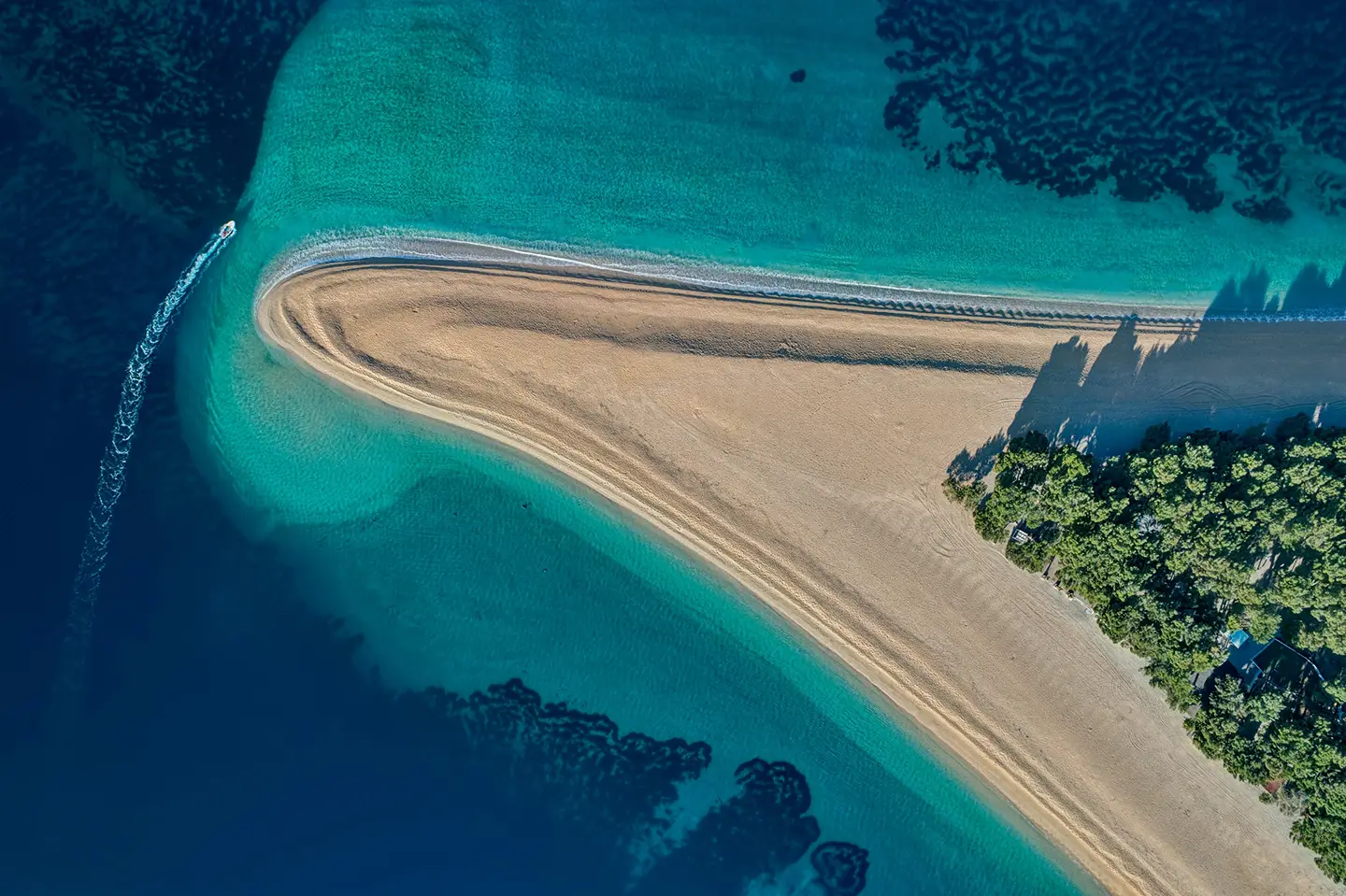
Catamaran charter Croatia itineraries — Adriatic sailing routes
— Sailing areas

Every route, by sailing area.

Pick the corner of Croatia that fits your week — each card opens onto every route from that base, day-by-day. We adapt the stops to weather, your group, and the kind of week you want.
Tell us about your week →
Split
9 routes
— Region 01 · 7–14 days
Sailing area Split

Split anchors the central Dalmatian charter cluster — Marina Kaštela 15 minutes from the airport, ACI Marina Trogir at the western end of Kaštela Bay, and a Saturday-to-Saturday week comfortably loops Šolta, Brač, Hvar, Vis and Korčula before turning back. Catamarans dominate the local fleet because the central Dalmatian anchorages are sheltered sand-bottomed bays where the wide-beam, 1.2-metre-draft catamaran sits comfortably at 4–8 metres while monohulls stand off in deeper water. The wind regime here defines the routing. The Maestral — the south-westerly thermal that builds from late morning through afternoon at 4–5 Beaufort — is the working sailing breeze of high summer; mornings tend calm, afternoons fresh on the beam reaching south-east through the islands. The Bura is the threat: a cold north-easterly katabatic that funnels off the Velebit massif, can build to 8+ Beaufort with little warning, and forces full-fleet shelter in the protected Šolta and Brač north-coast bays. The Jugo (south-easterly Sirocco) is the secondary risk in spring and autumn — slower-building but pushes 3-metre seas into Vis and Korčula's south coasts. Headline catamaran anchorages include Maslinica on Šolta (sheltered west-side cove with restaurant moorings), Milna and Bobovišća on Brač (deep horseshoe bays with town quays and lazy lines), Stari Grad on Hvar (the long inlet and 4th-century BC Greek archaeological site), Komiža on Vis (free quay under the Hum cliffs), and Pomena on Mljet (the National Park inlet). Vis itself was a Yugoslav military zone closed to foreigners until 1989 and remains the least-developed central Dalmatian island — the headline catamaran destination for crews wanting low charter density.

Explore Split routes
Dubrovnik
7 routes
— Region 02 · 7–14 days
Sailing area Dubrovnik

Dubrovnik charters live on the southern flank of the Dalmatian coast — ACI Marina Dubrovnik in Komolac (just behind the Old City), Marina Frapa Dubrovnik on the south side, and the smaller Marina Lapad as the boutique alternative. Catamarans dominate the fleet for two reasons: the southern Adriatic islands (Mljet, Lastovo, Korčula, Lopud) are characterised by sheltered shallow-water anchorages where the wide-beam 1.2-metre-draft catamaran sits comfortably, and the family-friendly southbound week (Mljet Day 1, Korčula Day 2, Lastovo Day 3–4) is the canonical first-bareboat itinerary in the country. The wind regime is the gentler end of the Croatian coast: the Maestral thermal builds from the south-west at 3–5 Beaufort through summer afternoons, evenings settle calm, and the Bura risk drops noticeably south of Pelješac. The Jugo south-easterly is the autumn-spring threat — builds 3-metre seas into Mljet's south coast and forces shelter in the Polače inlet on the north side of the island. Headline catamaran anchorages include Polače and Pomena inside Mljet National Park (saltwater Veliko Jezero lake with a 12th-century Benedictine monastery on the small island within the lake), Šipan Town on Šipan (the sheltered northern bay with the Renaissance ducal palace), Lopud (white-sand Šunj Bay on the east side, a 90-minute walk from the village quay), Korčula's Lumbarda (sheltered south-east cove with the Grk wine vineyards), and Lastovo's Skrivena Luka — "Hidden Harbour" — the deep south-coast inlet that is fully protected from any wind direction and is the catamaran's bombproof overnight.

Explore Dubrovnik routes
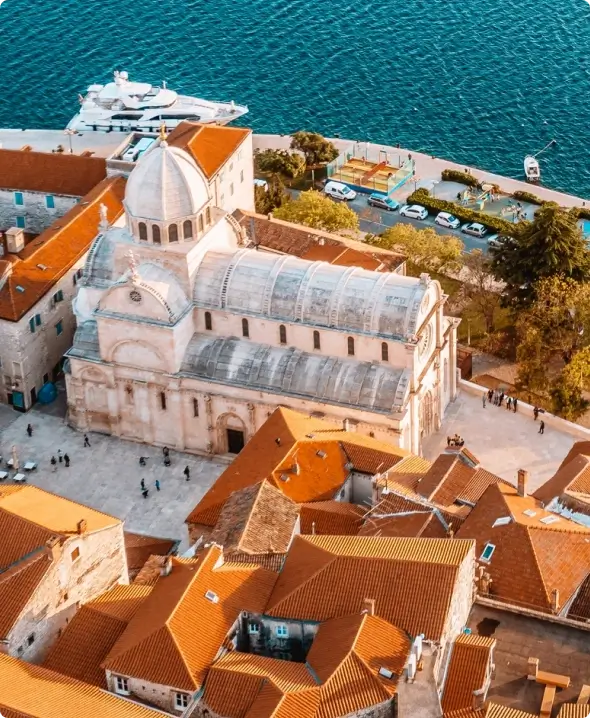
Sibenik
11 routes
— Region 03 · 7–14 days
Sailing area Sibenik

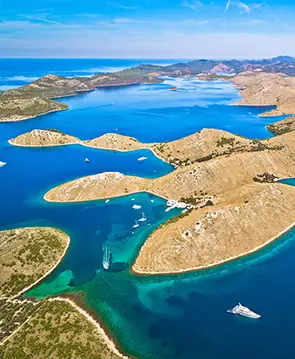
Šibenik anchors the access to two of Croatia's three best-protected national parks — Kornati (sea-based, around 110 islands of stark Mediterranean limestone) and Krka (river-based, the seven-step waterfall cascade) — both reachable in a single day-sail from base. Marina Mandalina (D-Marin) is the main charter hub, Marina Frapa Rogoznica is the second base, and a 90-minute bus connects from Split airport. Catamarans dominate the fleet because the Kornati anchorages are shallow sand-bottomed coves where the wide-beam 1.2-metre-draft platform sits inside while monohulls stand offshore. The wind regime is the working Maestral south-westerly at 3–5 Beaufort through summer afternoons, with the morning calms across the channel into the Kornati. The Bura katabatic risk drops south of Velebit's main shadow line — Šibenik is rarely caught in the worst gusts, but the channel inside the islands focuses any northerly into a gusty fetch that can stress the lazy-line stern-tos in the open quays. The Jugo southerly is the autumn-spring risk and forces shelter on the lee sides of the Kornati outliers. Headline catamaran anchorages include Žirje Town (the working fishing-village quay on the south end of the Kornati outer chain), Levrnaka and Lavsa inside the National Park (mooring-only restaurant-buoy taverna nights with the Kornati seascape), Telašćica Bay on Dugi Otok (the long fjord-like inlet at the north end of the park boundary), Skradin on the Krka river (the only catamaran-friendly anchorage upstream — UNESCO-listed Krka National Park boat tours run from the village), and Primošten Town (the medieval peninsula village with the photogenic vineyard slope and a sheltered municipal quay).

Explore Sibenik routes
Istria
7 routes
— Region 04 · 7–14 days
Sailing area Istria

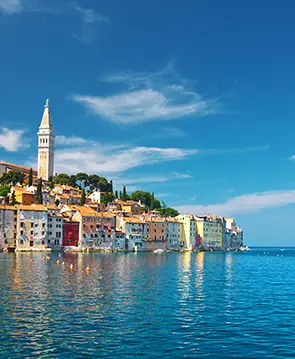
The Istrian charter cluster sits in northern Croatia and serves a different sailor profile from Dalmatia — short passages between sheltered Kvarner Gulf islands, easier road access from Slovenia, Italy and Austria via Trieste or Ljubljana, and a calmer wind regime that suits family crews and first-bareboat catamaran charters. Marina ACI Pula, Marina Pomer at the south end of the Pula peninsula, and Marina Punat on Krk handle the bulk of fleet embarkations. The wind regime is the country's gentlest. The Maestral south-westerly builds at 2–4 Beaufort through summer afternoons, the Bura katabatic from the Velebit massif reaches Istria much weaker than central Dalmatia (the Učka mountain range absorbs most of the gust energy), and the morning calms across the Kvarner channel are reliable enough that the daily routine is afternoon-only sailing with morning anchorage swims. Distances are short — Pula to Brijuni is 4 NM, Pula to Cres 18 NM, Krk to Lošinj 22 NM — and almost everything is line-of-sight inside the Kvarner Gulf. Headline catamaran anchorages include the Brijuni archipelago (14 islands of the National Park north of Pula — mooring-only inside the boundary, the inland excursion is the Roman villa ruins and Tito's safari zoo from his presidential retreat), Lošinj's Mali Lošinj town quay (the sheltered southern bay with the dolphin-watching reputation — resident bottlenose pod tracked since the 1990s), Cres Town (the deep northern inlet with the Venetian-era waterfront), and the Krk Punat lagoon (the shallow inland bay with the Košljun monastery on the small island within the lagoon).

Explore Istria routes
Zadar
12 routes
— Region 05 · 7–14 days
Sailing area Zadar

The Zadar charter cluster sits at the north end of central Dalmatia — Marina Sukošan and Marina Kornati Biograd are the main bases, with Marina Tankerkomerc on the Zadar town quay as the third option. Catamarans dominate the local fleet because the headline destination is the Kornati National Park (around 110 islands, mostly uninhabited, sheltered shallow-water anchorages); the wide-beam shallow-draft catamaran sits inside the protected coves at 4–6 metres on sand seabeds where deeper-keel monohulls have to stand offshore. The wind regime is gentler than the southern Dalmatian coast — the Maestral builds from the south-west at 3–5 Beaufort through summer, but the Bura katabatic threat from the Velebit massif is sharper here than further south (gusts above 30 knots have been recorded across the channel into Pag with little warning). Catamaran crews check the marine forecast before any leg west of the Velebit shadow line. The Jugo (south-easterly) is rare in summer but builds through autumn into 3-metre swells. Headline catamaran anchorages include Telašćica Bay on Dugi Otok (the long fjord-like inlet with the 100-metre cliff overlooks and the salt lake on the southern shore), Žakan and Levrnaka inside the Kornati National Park (mooring-only zones, restaurant-buoy taverna nights, the photogenic Kornati seascape), Pag Town on the western shore of the Pag salt-flats island (catamarans anchor on sand off the medieval centre), and the Pakleni Islands chain west of Hvar (sheltered south-coast coves for the Hvar nightlife crews on the way south).

Explore Zadar routes

How to choose a catamaran charter Croatia route

Croatia's coastline gives you five distinct sailing regions, each with its own character. The classic catamaran charter Croatia week is built around one of them — but a two-week charter or a one-way crossing lets you stitch two together. Below is the short version: who each area suits, how the typical Saturday-to-Saturday week looks, and what to weigh up when you pick.

Whatever route you pick, the rhythm is similar: morning swim, midday sail with the afternoon Maestral, late-afternoon arrival in a sheltered cove or marina, dinner ashore at a stone-walled konoba. Distances are short — most days are 12–25 NM, leaving plenty of time at anchor. Park-permit paperwork (Kornati, Mljet, Brijuni, Telašćica) is handled by our team when you book.

— Plan your week

Want a route built around you? Just ask.

Send your dates, departure base and crew size. A broker replies with a tailored itinerary and matching catamarans — usually within the same business day.