Split, Trogir or Šibenik? Picking Your Catamaran Base for 2027
Split, Trogir or Šibenik? A practical comparison of Croatia’s three central catamaran bases on transfers, berths and the routes each one opens up.
Read more
Updated May 2026.
The Croatian charter market has shifted toward catamarans faster than almost any other Mediterranean cruising ground over the past decade. At most major bases — Split, Trogir, Šibenik, Zadar, Dubrovnik, Pula — the new-build charter fleet is now 60-70% catamaran. The shift isn’t fashion. It’s the specific match between modern charter catamaran capabilities and Croatian coastal conditions. This piece is the working list of nine practical reasons a catamaran wins for a Croatian charter, written for people deciding between a cat and a monohull for an actual booking. For the full Croatian picture, our complete Croatia catamaran charter guide covers regions, bases, costs and season choice.
Croatia’s coast doesn’t get the meltemi the Cyclades do, but the prevailing northwesterly maestral builds reliably from late morning, peaks in the mid-afternoon at 15-22 knots, and drops at sunset. That builds a 0.5-1.5 m beam-on swell across the channels between islands — perfectly safe, but uncomfortable on a monohull that’s heeling 15-20 degrees. The catamaran’s twin hulls stay essentially level under sail, with maybe 3-5 degrees of inclination at the heaviest settings. For families with kids, multi-generational charters, or any crew that includes non-sailing partners, this single difference defines the week. Seasickness rates drop sharply; mealtimes work normally on the move; cockpit-table dining underway is realistic.
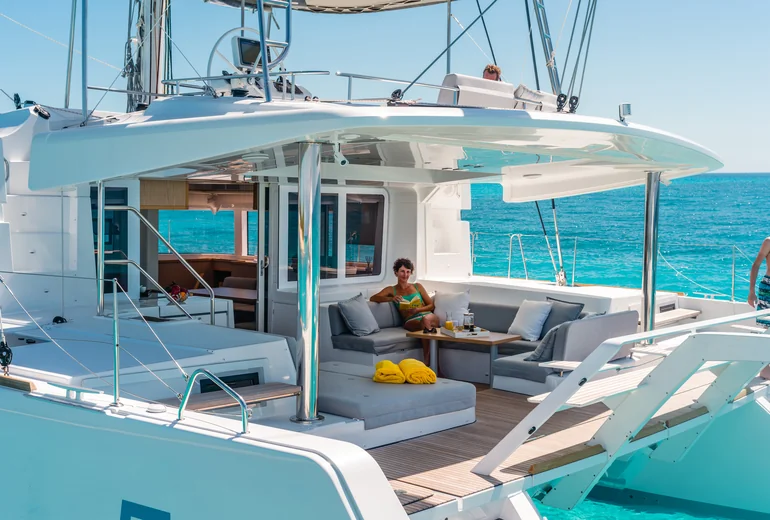
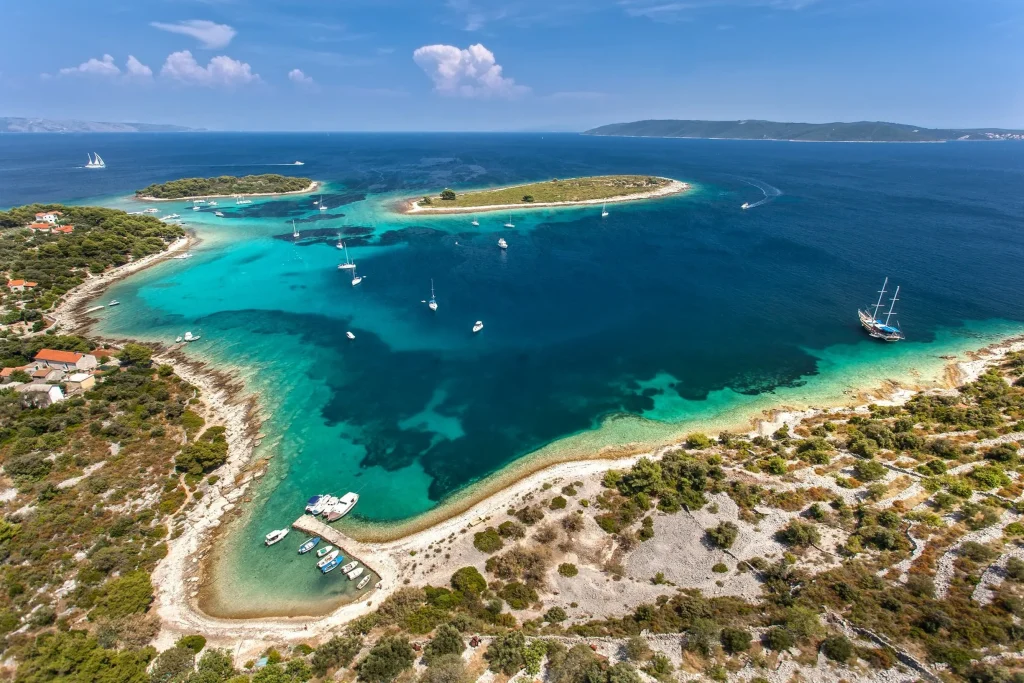
Croatian inshore anchorages are shallower than the rest of the Mediterranean. Most charter catamarans draw 1.1-1.4 metres; comparable monohulls draw 1.8-2.2 metres. That half-metre difference is the difference between dropping the hook in the cove and watching from outside. The Pakleni archipelago’s smaller bays, the inner bays at Kornati, Mljet’s secondary anchorages, the shallow approaches into Vis’s east-coast coves — every one of these reads “catamaran-friendly” in the practical detail. Our Vis must-see guide walks through specific examples where draft matters; the Kornati on a catamaran piece does the same for the northern archipelago.
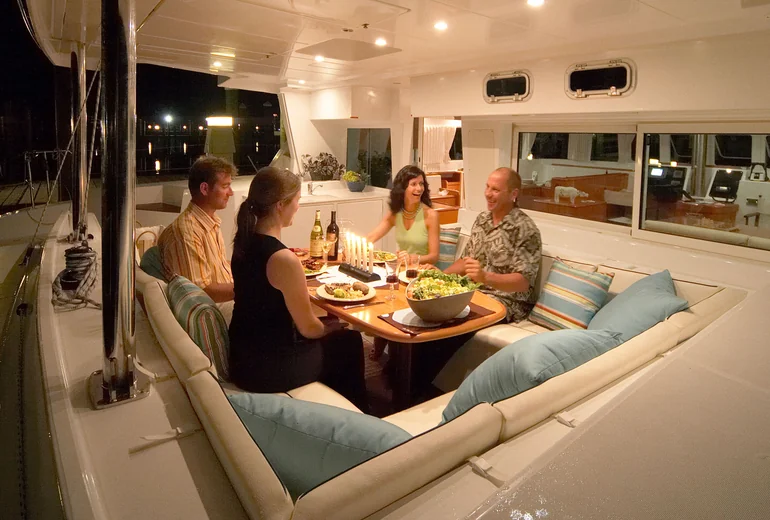
A 45-foot catamaran has roughly the interior and deck volume of a 60-foot monohull. The cockpit is flat, big enough to seat 8-10 around a table. The saloon sits at deck level with 360-degree visibility — not below the waterline like a monohull saloon. The bow trampolines work as a sun deck for four. The result: family or friend groups of 6-10 people share a 45-50 ft catamaran in real comfort, where the same group on a monohull would crowd a 55+ footer. The cost-per-person on a charter cat trends favourably above 6 paying guests; below that, monohulls win on per-person economics. For groups of 4 or smaller, that calculus inverts.
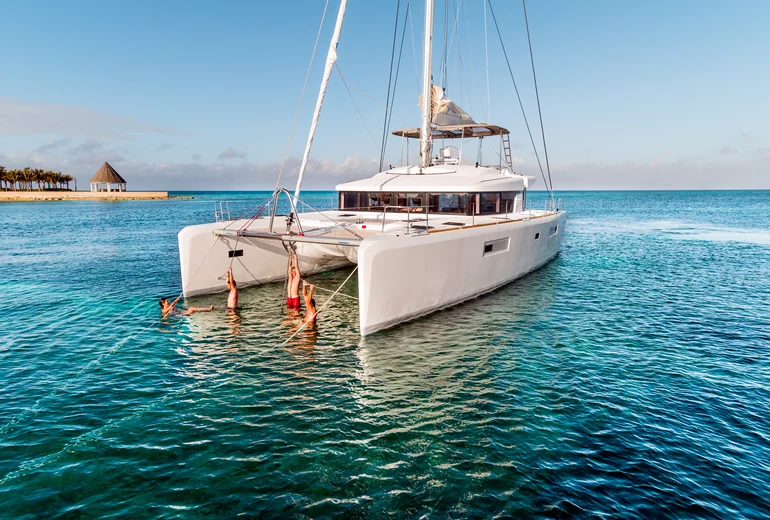
The standard 45-foot charter catamaran ships in a 4-cabin layout, with each double cabin housed in its own hull section, separated by the saloon. For shared charters where two or three couples or families take one boat, this matters: every cabin has a private head, its own door, and acoustic separation from the others. The 4+1 charter version typically adds a forward 5th cabin in one hull; the 6-cabin layouts split the hulls further for maximum berth count. Compare to a typical 45-foot monohull’s layout: V-berth forward (no privacy from the saloon), an aft port cabin and aft starboard cabin (separated by a wooden bulkhead, not a hull section), and one or two heads shared by all. For shared charters, the cat’s privacy advantage is decisive.
The cliché that “catamarans don’t sail” applied to early-2000s charter cats. Modern designs — Lagoon 46, Bali 4.6, Fountaine Pajot Astréa 42 and Saona 47, Excess 12, Catana 53 — are properly capable in the 10-20 knot wind band that defines the Croatian summer. Reach speeds of 7-9 knots are routine. Pointing angles are not racing-tight, but 90° tack angles in 15 knots true are realistic, which is good enough for the Croatian point-to-point sailing the route patterns demand. In the lighter mornings, the asymmetric Code 0 (standard on most charter cats now) lets you sail comfortably in 8-10 knots. Many Croatian charter weeks see the engines off for 70%+ of underway hours. The boat sails.
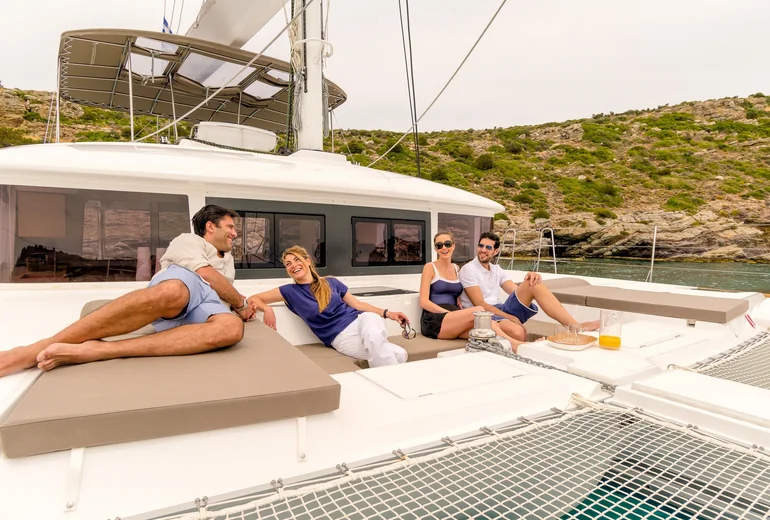
A Croatian family charter typically carries: 2-3 paddleboards, snorkel sets for the crew, fishing kit, beach kit, plus the standard bags and provisions. A monohull stows this awkwardly — paddleboards on the foredeck, snorkels in cabin lockers, kayaks lashed against the rail. A catamaran handles it all naturally: paddleboards on the bow tramps when not in use, kayaks on the sugar-scoop platforms, snorkel kit in the dedicated cockpit lockers, with kids’ gear staying where they need it (cockpit) instead of where there’s space (cabin floor). The twin swim platforms at the stern give independent access for parents and kids — one parent watches kids in the water while the other tends to lunch on the cockpit table. The everyday logistics of family charter sailing simply work better on a catamaran.
Twin engines simplify mooring. Catamarans dock alongside or in stern-to mooring with a level of control monohulls can’t match — drive each engine independently, the boat rotates in its own length. Croatian Adriatic stern-to mooring (the standard in marquee harbours like Hvar town, Korčula, Vis town, Komiža) becomes materially less stressful for first-time bareboat skippers. The catamaran’s higher windage adds caution at the dock, but the twin-engine advantage outweighs it for everyone except advanced monohull sailors with years of stern-to practice. For mixed-experience crews where one person is the skipper and the others want to enjoy themselves, the catamaran is the obvious choice. Confirm specific licensing requirements in our how to book a catamaran guide.
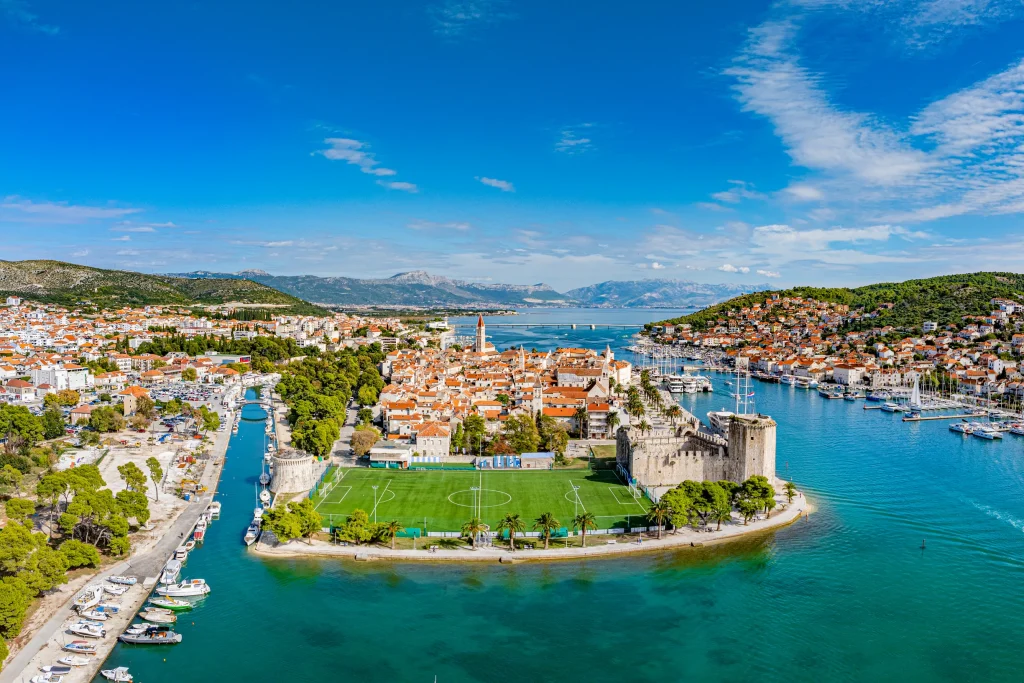
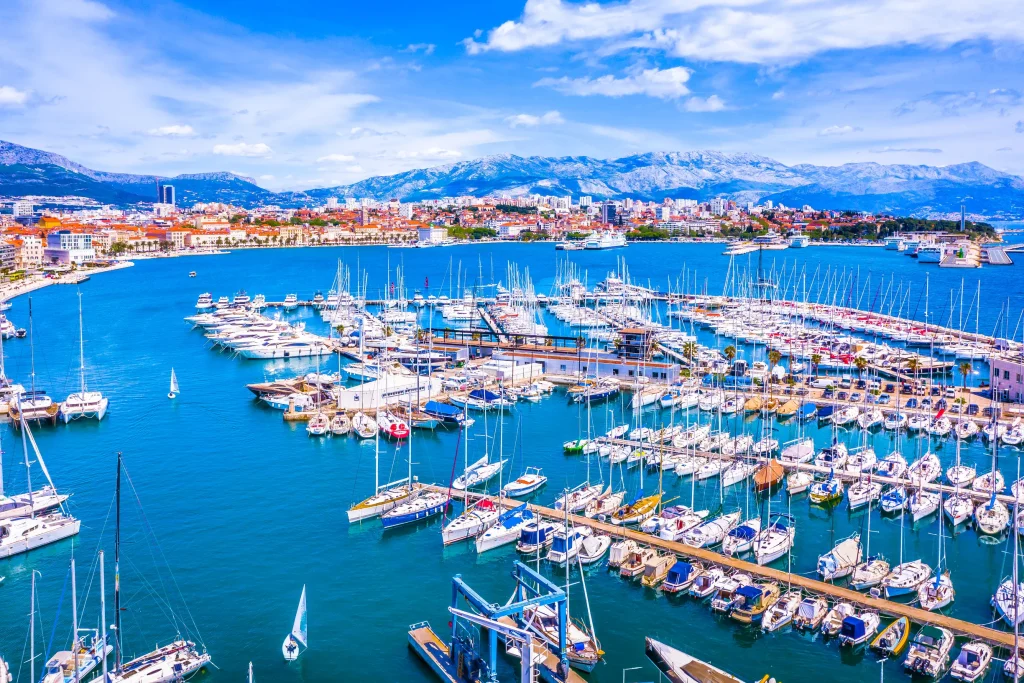
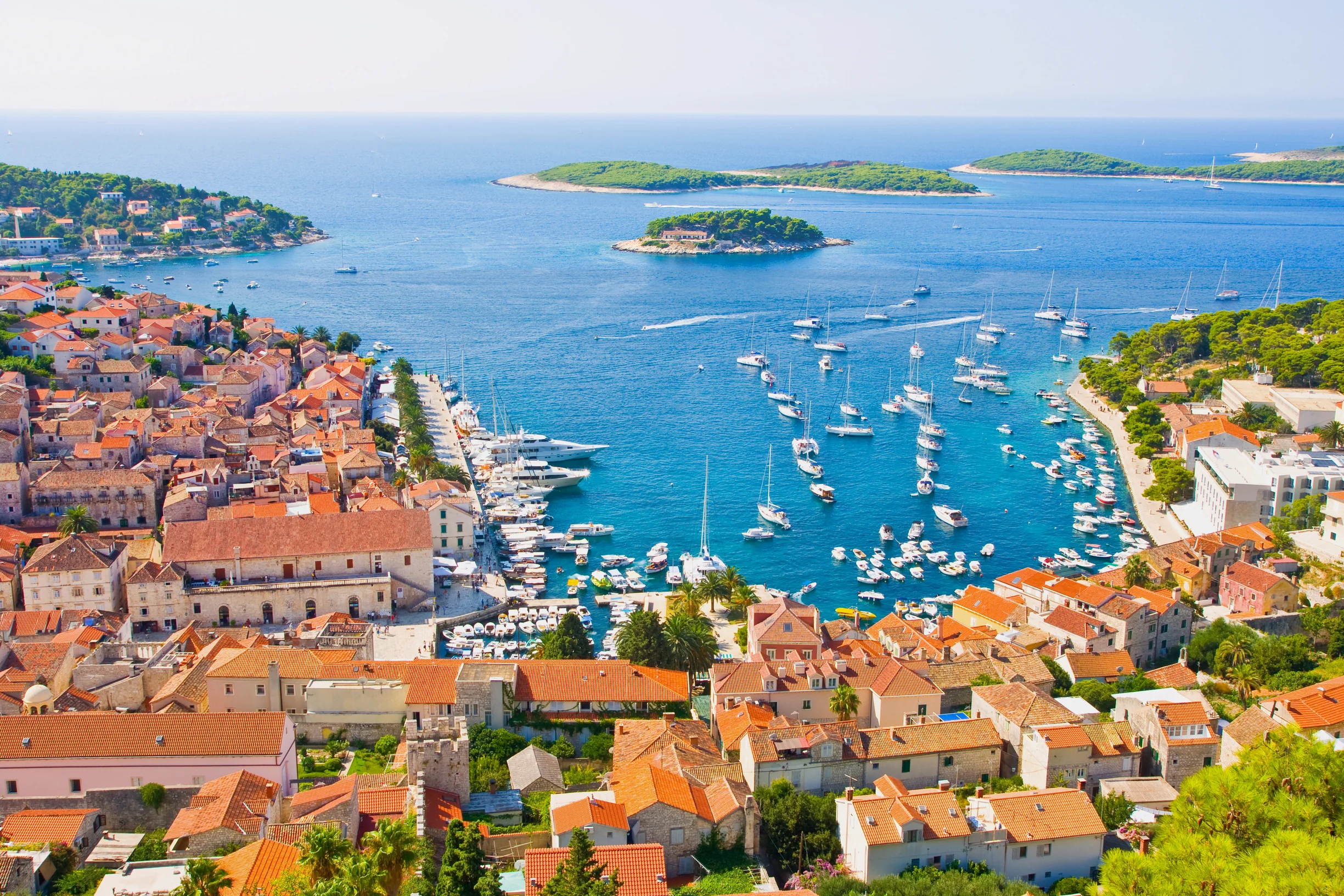
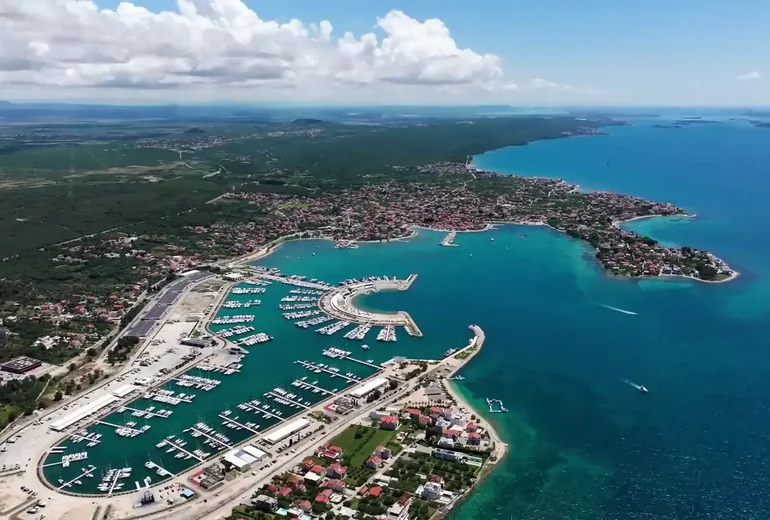
The depth of Croatian charter infrastructure is the underrated advantage. Split (ACI Split + Marina Kaštela) holds the largest catamaran fleet in the Mediterranean. Trogir (ACI Trogir + Marina Baotić) is 15 minutes from Split airport with calmer Saturday handover, mid-sized catamaran selection. Šibenik and Biograd serve the North Dalmatia and Kornati cruising grounds. Dubrovnik (ACI Komolac + Marina Frapa Dubrovnik) anchors the south. Pula and Pomer handle Istria. Every base has same-day repair access, English-speaking handover teams, and a fleet of modern catamarans typically 1-5 years old. The booking-window logistics — security deposits, fuel handovers, marina pre-bookings — are equally well-handled at all of them. Picking a base is about cruising ground, not infrastructure.
Croatian summer evenings are long — sunset around 20:30 in mid-July, last light past 21:30. That window between sundown and dinner is the social heart of a Croatian charter day, and the cat’s deck layout maximizes it: cockpit table for 8, bow trampolines for beanbags, flybridge (where fitted) above the saloon roof, twin sugar-scoop platforms for one last dip. On a monohull, the same hour happens in a smaller cockpit, sometimes with the boat rolling on the anchor. More space, more vantage points, more comfortable surfaces for the rhythm Croatian summer evenings fall into naturally.
Not every Croatian charter case favours a catamaran. Couples or 4-person crews get a better per-person rate on a smaller monohull — the catamaran’s space advantage is wasted on a half-empty boat. Sailing-first crews who care about pointing angle, heel, and the feel of a boat moving through water gravitate to monohulls; the cat’s flat deck is exactly the experience they’re trying to avoid. Budget-driven trips see the catamaran charter rate at 2.5-3× the monohull equivalent — the gap is real and meaningful for cost-sensitive bookings. None of these reverse the broader trend toward catamaran chartering, but they’re the legitimate cases where the monohull stays the right call.
The full Croatian region-by-region breakdown — Central Dalmatia, North Dalmatia, South Dalmatia, Istria — sits in our complete Croatia catamaran charter guide. For specific routes, the 7-day Split-to-Dubrovnik itinerary covers the marquee Central Dalmatian week and the Zadar/Kornati route handles the northern archipelago. For an island-deep-dive, the Vis must-see by catamaran piece walks through one of the most distinctive Croatian cruising stops. Layout and group-fit questions go through our how to select the right catamaran for your group.
For families with kids, groups of 6+ adults, multi-generational charters, and any crew that includes non-sailing partners — yes. The stability, deck space, privacy, and shallow-draft anchorage access map cleanly onto Croatian conditions. For sailing-first couples or 4-person crews who prioritise the sailing experience over comfort, the monohull remains the better fit. The decision is about crew profile, not about which boat is “objectively” better.
Yes. Croatia requires the registered skipper to hold a recognised sailing licence (ICC, RYA Day Skipper, US Sailing Bareboat or equivalent) plus a separate VHF radio certificate. Most operators verify both at handover. If no one on your crew is qualified, hire a professional skipper — a standard add-on at €1,750-2,000 per week — and the licensing burden is removed entirely.
Split for the largest fleet and most direct flights. Trogir for the calmest Saturday handover and the shortest airport transfer (15 minutes). Šibenik or Biograd for the Kornati. Dubrovnik for the southern Adriatic and Montenegro-extension routes. Every base has strong catamaran selection — the decision is driven by which cruising ground you want, not by infrastructure quality.
September. Water at its summer peak (24°C), schoolkids back at school, marina prices off-peak, the maestral at its most predictable. Late June is the close second — slightly cooler water but the marquee Hvar/Pakleni crowds haven’t fully arrived. Avoid August (Italian-German vacation overlap, peak marina pressure, peak prices) unless you have no schedule flexibility.
Yes. A 45-foot bareboat catamaran in Croatia runs €13,000-18,000 a week in peak season; a comparable 45-foot monohull runs €5,500-7,500. Per-person economics shift with crew size — at 8 paying guests on a catamaran versus 6 on a monohull, the per-person cost is closer than the headline numbers suggest. For groups of 4 or fewer, the monohull stays the better economic choice; for 6+, the catamaran’s space advantage justifies the premium.