Luxury catamaran charter
in Croatia.
What a crewed catamaran week on the Adriatic really costs, what the crew does all day, and where the all-inclusive label does — and does not — apply. Written from the charter desk that places these boats.
Luxury on a Croatian catamaran is not a marketing word — it is a specific list: a hull around 50 feet or more, a generator that runs the air-conditioning overnight at anchor, a watermaker, and a crew who do the work while you swim. This guide explains what that list costs, which size fits your group, what a crewed week includes, where it starts and when to go — and where the “all-inclusive” label imported from the Caribbean does and does not apply on the Adriatic.
What counts as luxury on the Adriatic
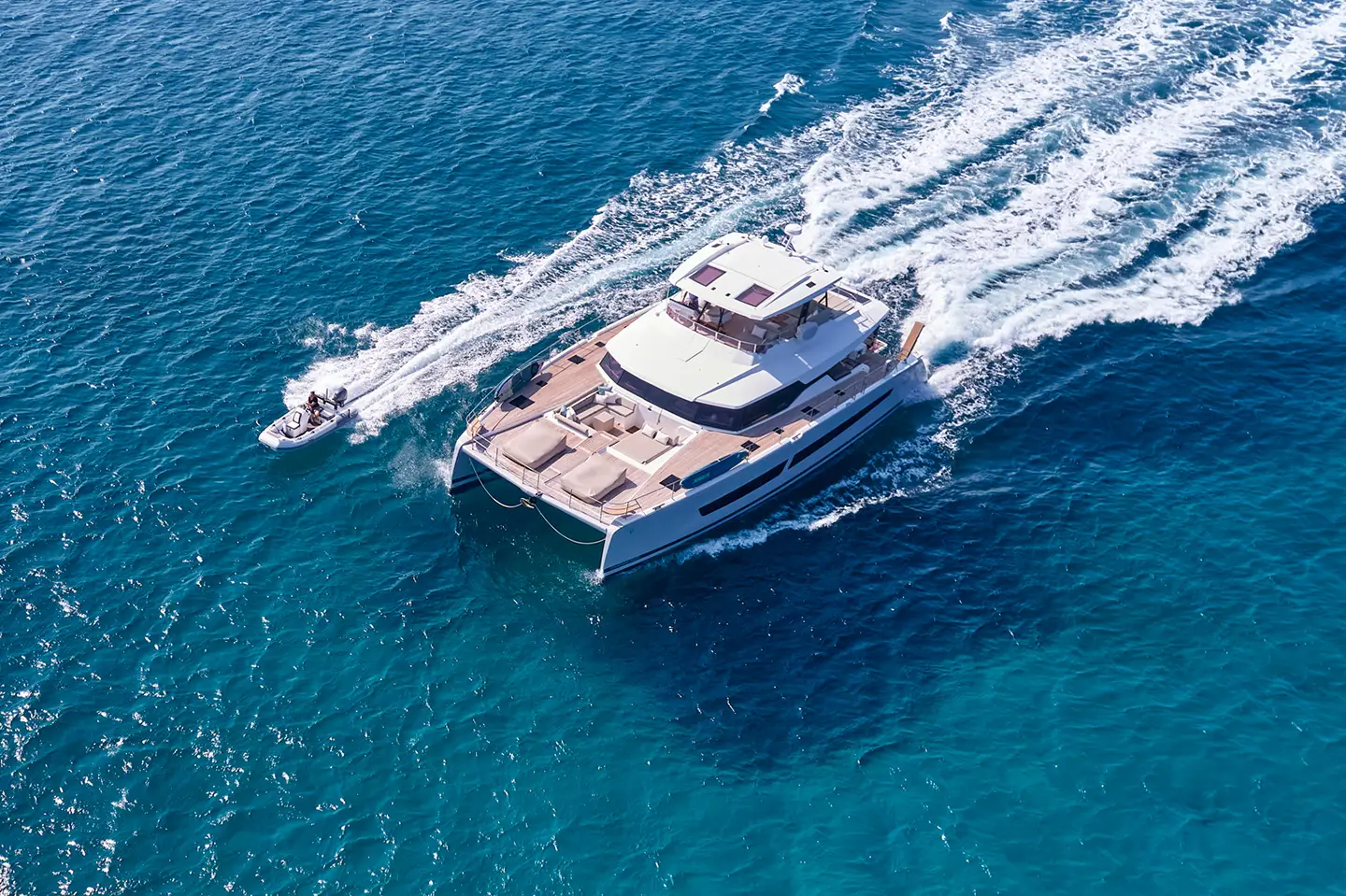
The Croatian charter fleet is mostly 40–46 ft sailing catamarans with four cabins — comfortable, but standard. The luxury segment starts where three things come together: size, systems and crew. Size means roughly 50 ft and up — flybridge designs such as the Lagoon 51 and 55, Fountaine Pajot Samana 59, Bali 5.4 and the Sunreef hulls at the top of the market. Systems means a generator sized to run air-conditioning away from the dock, a watermaker so nobody rations showers, and a proper tender rather than a small dinghy. Crew means at minimum a skipper and a hostess-cook; the flagships carry a full professional crew. A 42-footer with air-conditioning is a comfortable charter. It becomes a luxury charter when the boat, the systems and the people running it scale together.
Size bands, and who each one fits
Above the 50 ft entry class (Lagoon 51, Bali 5.4, usually a skipper plus a hostess-cook), luxury catamarans fall into three rough bands. Match the band to the group first, then shortlist two boats within it.
55–60 ft
Sweet spot for one family or two couples with kids. Four to five guest cabins work well. Strong shade and generous cold storage support warm months. The toy list covers SUPs and snorkel sets, with seabobs as add-ons on some models.
60–67 ft
Ideal for two families or four adult couples. Wider beam raises deck comfort, the flybridge hosts sunset service and the toy locker grows. Generator and watermaker support longer anchor runs without shore power.
70–80 ft
Yacht-grade presence with top chef talent and a larger tender. Five guest cabins are common, with storage for multiple toys and a beach-club setup — expect fast tender shuttles to town quays and private coves. Only a handful of hulls this size charter in Croatia, so availability is the first filter.
Crewed, skippered or bareboat
Croatian catamarans charter in three formats. Crewed means the boat comes with a skipper plus a hostess or cook — on the largest hulls a full crew — and you do nothing but decide where to swim. Skippered means you take a standard charter cat and add a licensed local skipper while your group handles its own catering; our skippered catamaran guide covers rates and how the skipper's day works. Bareboat means you sail yourself, which requires an ICC-recognised licence and a VHF certificate — the full requirements are in our bareboat charter guide. Luxury lives almost entirely in the first category: above roughly 55 feet most owners will not release a boat without professional crew.
What “all-inclusive” actually means in Croatia
In the Caribbean, crewed catamarans commonly charter on a genuine all-inclusive rate: boat, crew, food, bar and toys in one number. Croatia works differently. A Croatian crewed catamaran almost always prices the boat and crew first, with food and drink arranged separately — through a provisioning list or a galley kitty the hostess shops from. Some of the largest crewed yachts run a Caribbean-style APA (advance provisioning allowance: a float of roughly 25–30% on top of the charter fee, settled against receipts). On top of the rate, expect the standard Croatian extras: transit log and final cleaning, tourist tax, fuel for the miles you motor, marina berths and national-park entries. When a listing says all-inclusive, ask for the line items — an honest operator sends them without being asked twice.
Kitty or APA: how the extras are settled
Food, fuel and berths are settled beside the boat-and-crew rate in one of two ways. On most Croatian crewed cats you pay them as the week goes: food and drink through the provisioning list or the kitty, fuel and marina nights as they come up. Some of the largest yachts run an APA instead: the crew draws on the fund for fuel, food, drinks, berths and permits, reconciliation arrives with receipts near the end of the week, and any unused balance comes back to you — a top-up happens only with your approval.
Private charter means the whole boat
A private charter gives your group the entire catamaran: every cabin, the route, the pace. That is what almost every listing on this site is. The alternative — cabin charter, where you buy a single double cabin aboard a shared boat that keeps a fixed route and fixed meal times — exists in Croatia and suits couples on a budget, but it is a different product. The prices are not comparable: a private week buys the whole boat, and everyone's week on it.
- A passage plan each morning, built around the forecast and your wishes — not a fixed route.
- Berths, buoys and marina slots called ahead, so evening never means circling a full harbour.
- Breakfast and lunch aboard from the hostess-cook; dinner ashore at the konoba she recommends.
- Tender runs to beaches and town — and back, however late dinner finishes.
- Daily washdown, cabin tidy-ups and fresh towels.
- National-park tickets, fuel, transit formalities and the charter log — no paperwork touches you.
- Generator sized to run air-conditioning overnight at anchor, not only at the dock.
- Watermaker, so showers are never rationed in an August week.
- Flybridge helm or forward lounge — separate spaces to be together and apart.
- A proper tender with a strong outboard; flagships carry jet RIBs.
- Paddleboards and snorkel gear as standard; larger water toys on flagship hulls.
- A double cabin with ensuite heads for every couple aboard.
Who is aboard, and how a day runs
Core roles are skipper, chef and hostess — on the 50 ft class one hostess-cook usually covers both galley and cabins — and larger boats add a deckhand. The skipper owns route design, safety, berths and the tender; the chef owns menus, sourcing, plating and allergies; the hostess runs cabins, table service, coffee and snacks; the deckhand handles toys, lines and shore setups. The guest-to-crew ratio stays tight, and that is where the attention to detail comes from.
- 08:30 — breakfast service
- 10:00 — lines off for a 12 NM run
- 12:00 — anchor drop and a swim block
- 13:30 — light lunch under shade
- 15:00 — toys and beach time
- 18:00 — sunset pass along the promenade
- 20:00 — plated dinner on deck, or a table booked ashore
- The yacht and its crew
- Bed linen and towels
- Dinghy with outboard
- Safety gear, checked with you at handover
- Tea, coffee, soft drinks and standard snacks on premium packages
- Wi-Fi on many crewed programmes
- Moorings and marina nights, priced per night by length and port
- Fuel for main engines, generator and tender runs — often drawn from the APA
- Seabob or e-foil, by quote and availability
- Transfers from the airport or your villa to the marina
- Tourist tax, charged per guest
- Crew gratuity: 10–15% after a strong week, at your discretion
Where a crewed week starts
- Split — ACI Marina Split, a walk along the harbour from Diocletian’s Palace, and Marina Kaštela between the city and the airport. Short legs to Brač, Šolta and Hvar.
- Trogir — ACI Marina Trogir faces the UNESCO old town across the channel, a short drive from Split airport.
- Šibenik — Marina Mandalina, inside the sheltered Šibenik bay: the entry point for the Kornati and Krka national parks.
- Zadar — the city marinas and Marina Dalmacija in Sukošan, for the northern island chains and quiet bays.
- Dubrovnik — ACI Marina Komolac, with strong services and quick runs to the Elaphiti islands.
Each base has its own wind rhythm and marina strategy; our route guides by sailing area cover them in detail.
A sample crewed week from Split
A gastronomy loop through the central Dalmatian islands. Daily legs run roughly 10–25 NM, the longest on the crossing to Vis, and the skipper reshapes the order around the forecast.
- Day 1 — ACI Marina Split to Milna on Brač. Fresh pasta and salads for a soft start.
- Day 2 — On to Palmižana, among the Pakleni islands. Tender to Hvar town for a wine flight.
- Day 3 — Palmižana to Stari Grad. The chef grills local fish at anchor.
- Day 4 — Stari Grad to Vis town. Late lunch in a quiet cove en route.
- Day 5 — Morning at Biševo’s Blue Cave, evening in Komiža. Dessert under the stars.
- Day 6 — Komiža to Šešula bay on Šolta. Sunset paddle and a light tasting menu.
- Day 7 — Šolta back to ACI Marina Split. Fuel, a stroll and a farewell dinner.
Prefer national parks or short hops? The Šibenik loop through Kornati and Telašćica and the Dubrovnik week around the Elaphiti and Mljet are in our sailing itineraries.
Toys, wine and the table
SUPs for dawn paddles, kayak tours along pine shores and snorkel trails above clear rock gardens are the everyday toys; seabobs and e-foil sessions run on select programmes, and a larger tender opens up beach clubs and long coves. For children, lifejackets, a buddy system and adult supervision on every tender run are the rule. At the table, island vineyards supply Pošip, Plavac Mali and local rosé; chefs pair white fish with crisp whites and slow-cooked lamb with bold reds. Allergies and dietary notes go on the preference sheet before provisioning, and menus rotate through grill nights, tasting menus and beach picnics.
When to go
- April–May — soft prices, fresh air and broad berth choice.
- June — long days and warm seas.
- July–August — peak pressure; early marina bookings pay off.
- September — warm water and calmer docks: the best-value month.
- October — quiet bays and gentle mornings.
Our best time to sail in Croatia guide breaks the season down month by month.
Realistic budget bands
Treat these as typical market bands for high season, not quotes — exact pricing depends on the boat, the week and the year. A crewed 50-foot sailing catamaran with skipper and hostess generally lands around €10,000–15,000 for the week before food and fuel. The 55–60 ft flagship class runs roughly €18,000–25,000 crewed, and the top of the market clears €25,000 comfortably, with luxury power cats above that again. June and September typically price well below peak — for exactly the same boat and crew.
The luxury fleet, and getting here from the US
The wider catamaran charter Croatia fleet we offer runs to several hundred boats across the main marinas — Split, Dubrovnik, Rogoznica, Zadar and Punat — but the crewed luxury slice at the top is thin, and the best hulls take peak-week bookings by late winter. Charter weeks run Saturday to Saturday as standard. American guests fly into Split (SPU) or Dubrovnik (DBV), usually with one European connection, and both airports are a short transfer from their charter marinas. Pricing is in euros and your card is charged in euros; your bank sets the conversion. If you want warm sea, open anchorages and softer rates, September is consistently the best-value month on the Adriatic. You can browse the current fleet with live availability and filter by size, cabins and equipment.
How booking a crewed week works
We are a charter agency with a desk in Split, not a call centre. Booking starts with an inquiry, not a payment: send your dates, group and budget band through the charter wizard and a charter agent replies with the crewed boats that actually fit. Nothing is charged until you confirm a specific boat and contract. From that moment you have 72 hours to cancel free of charge, which lets you hold the yacht while flights and the rest of the group fall into place. For peak crewed weeks, start the conversation five to eight months out; for June and September, three to four is usually enough.
Common questions, answered straight
How much is a crewed catamaran charter in Croatia?
As typical market bands, not quotes: a crewed 50 ft sailing catamaran with skipper and hostess generally runs €10,000–15,000 per week in high season, the 55–60 ft flagship class roughly €18,000–25,000, and the top of the market above €25,000. Food, fuel, berths and park fees come on top unless your contract explicitly includes them. June and September price noticeably below peak for the same boat.
What does all-inclusive include on a Croatian catamaran?
Usually less than the Caribbean version of the term. In Croatia the rate normally covers the boat and crew, while food, drinks, fuel, berths and national-park fees are paid separately — via a provisioning list, a galley kitty, or on larger yachts an APA of typically 25–30% settled against receipts. Always ask for the line items before comparing two “all-inclusive” offers.
Is a private catamaran charter worth it?
With six to ten guests, usually yes. Split a €12,000 crewed week eight ways and you are at €1,500 per person for seven nights of accommodation, a private crew and a moving sea view — compare that with peak-season hotel rates on Hvar or in Dubrovnik. For a couple travelling alone, a cabin charter or a smaller skippered cat is the more rational buy.
Do I need a license to charter a luxury catamaran in Croatia?
No. Crewed and skippered charters need no licence from you at all — the professional skipper carries the qualifications. A licence (ICC-recognised, plus a VHF certificate) is only required if you charter bareboat and skipper the boat yourself, which the 55 ft+ luxury fleet effectively never allows.
When should I book a crewed catamaran for summer in Croatia?
The crewed luxury fleet is the thinnest segment of the market, and the best hulls take July and August bookings by late winter. Start five to eight months ahead for peak weeks, three to four for June or September. The 72-hour free cancellation window means holding a boat early carries little risk.
Which catamaran size fits two families?
A 60–67 ft catamaran with four to five equal cabins and a strong flybridge lounge.
How does APA work on a crewed catamaran?
A set percentage of the charter fee — typically 25–30% — sits in a fund for fuel, food, drinks and berths. The crew pays suppliers from that fund, and any unused balance comes back to you with the receipts at the end of the week.
Do we need a marina every night?
No. Many plans mix buoys and anchorages with two or three marina nights for shore power and a stroll through town.
Which water toys suit teenagers?
Seabobs, e-foil sessions with a guide, and long SUP tours near coves with no swell lines.
What paperwork do guests need?
Passports valid for the trip, crew-list details for the port office, and a preference sheet about seven days before boarding so the chef can provision.
How does boarding day work?
A driver can meet your flight or villa — we arrange transfers from Split and Dubrovnik airports — and your bags go straight to the boat. The crew walks you through cabins and safety, usually over a welcome drink in the cockpit.
Want the crewed week? Tell us your dates.
Send dates, group size and a budget band. A charter agent in Split comes back with the crewed catamarans that fit, each with an itemised price — typically the same working day.