10–14 Days on a Catamaran: the Whole Croatian Coast from Zadar to Dubrovnik
A 12–14 day one-way catamaran route down the whole Croatian coast, from the Kornati to the Elaphiti, with pacing and one-way drop-off tips.
Read more
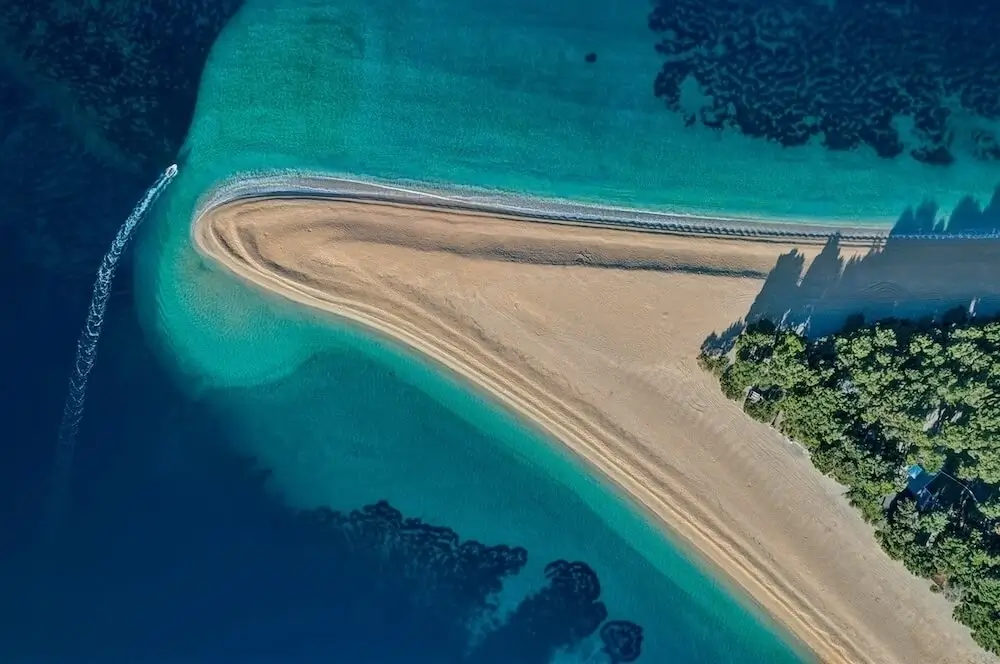
Croatia’s mainland coast and 1,244 islands make it the densest island-hopping cruising ground in the Mediterranean. A luxury catamaran here is not a status statement — it is the practical answer to the question of how to sleep eight in private cabins, run a stable platform across the open Adriatic, and still anchor in coves where a deep-keel monohull cannot reach. Below are the ten reasons charterers come back to Croatia, with concrete numbers, place names, and seasonal advice.
The crossing from Split to Vis (38 nautical miles) and from Dubrovnik to Korčula (50 nm) often involves an afternoon Maestral of 15–22 knots on the beam. A 50-foot luxury catamaran handles those crossings with the espresso machine still on the table. A monohull of the same length will heel 15–25 degrees, which is fine for sailors, but rarely fine for guests who have flown in from London or New York that morning.
Stiniva on Vis (3 m draft into the bay), Mljet’s Veliko Jezero, the inner Pakleni Islands chain off Hvar — these are the photo destinations of every Croatia charter. A catamaran’s typical 1.2–1.5 m draft means you anchor inside, not at the entrance with a 30-minute tender ride.
A Lagoon 51, Bali 5.4, or Fountaine Pajot Saona 47 sleeps eight guests in four en-suite double cabins, plus crew quarters in the bow nacelles. The same eight on a monohull need a 60-foot boat — and the per-week cost gap is typically 35–55%.
On a charter where guests are a mix of couples, parents, and teenagers, the catamaran salon-and-cockpit becomes the de facto family room. You can host eight people with a chef working on board without anyone needing to retreat below. On a monohull, salon space is roughly half what a comparable catamaran offers.
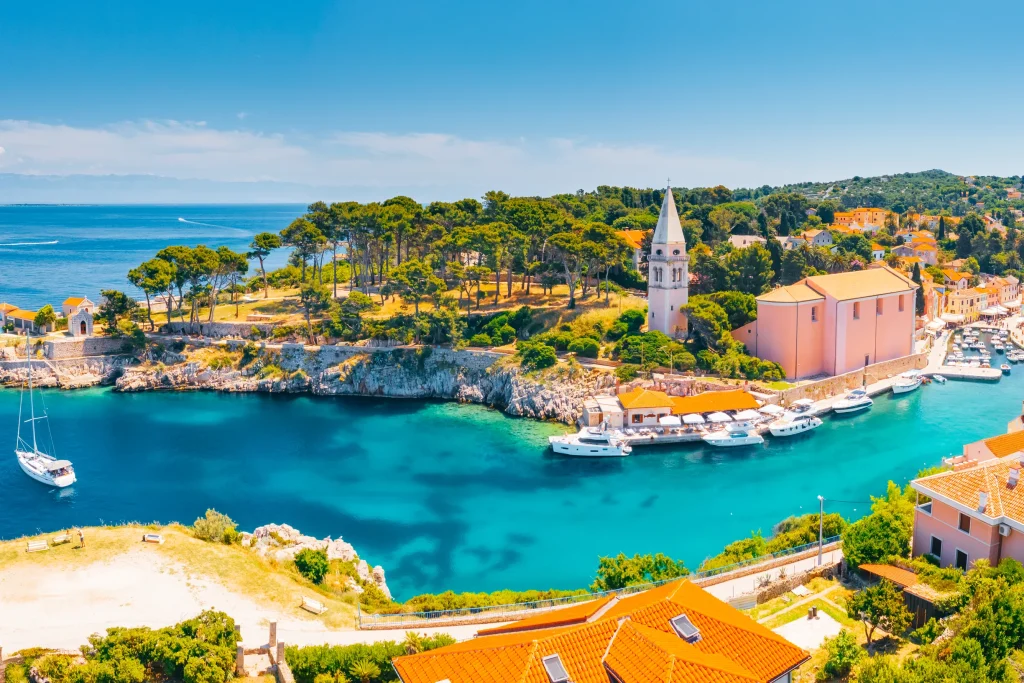
The Croatian charter ritual: drop the anchor, take the line ashore, walk five minutes to a konoba. Order peka (lamb or octopus baked under a bell-shaped iron lid for two hours), drink a glass of Pošip from Korčula or Plavac Mali from Hvar, watch the bay turn glass-still as the Maestral fades. Ston, Pučišća on Brač, Vinogradišće on Sveti Klement — every catamaran charter ends up in a few of these.
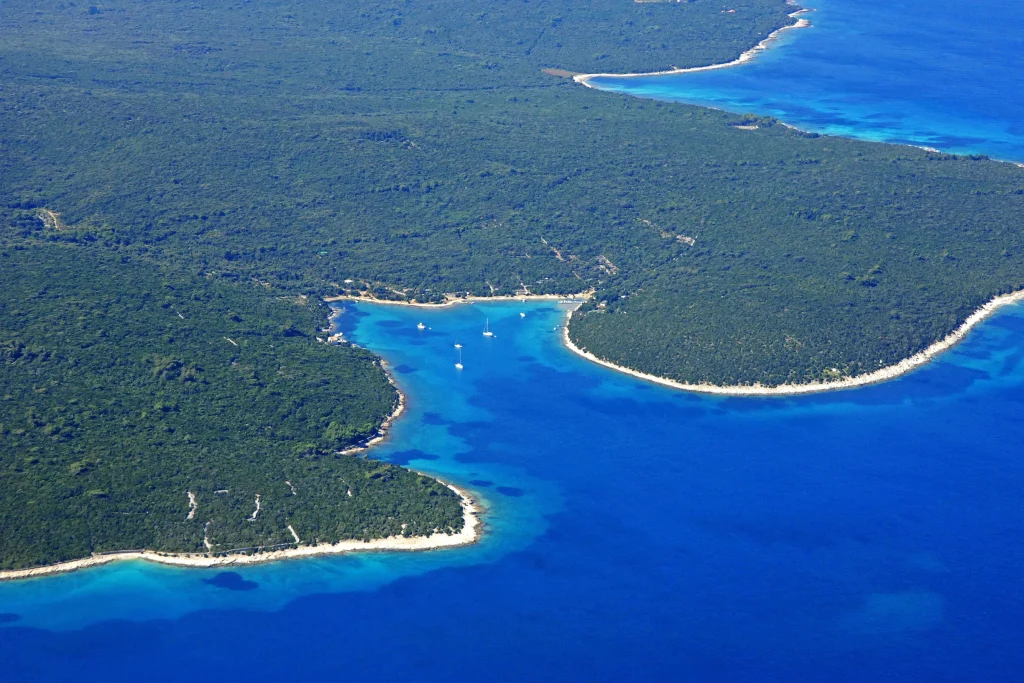
The Kornati National Park is 89 islands across 89 nautical miles, mostly uninhabited, with only one fuel berth (Piškera). A catamaran’s water capacity (typically 800–1,000 litres) plus the foredeck space for a 60–80 m kedge mean you can spend 3–4 nights in the park without needing to come back to a fuel marina. Reservation is mandatory through the park office (around 380–520 EUR per night for a 50-foot cat).
The Adriatic Maestral builds from late morning, peaks 15–22 knots in the afternoon, and dies within an hour of sunset. The Bura (offshore katabatic from the Velebit range) is the exception, and any responsible charter agency cancels or routes around it. Most charter weeks see 4 of 7 sailing days under 18 knots — comfortable conditions for a luxury cat under main and reefed genoa.
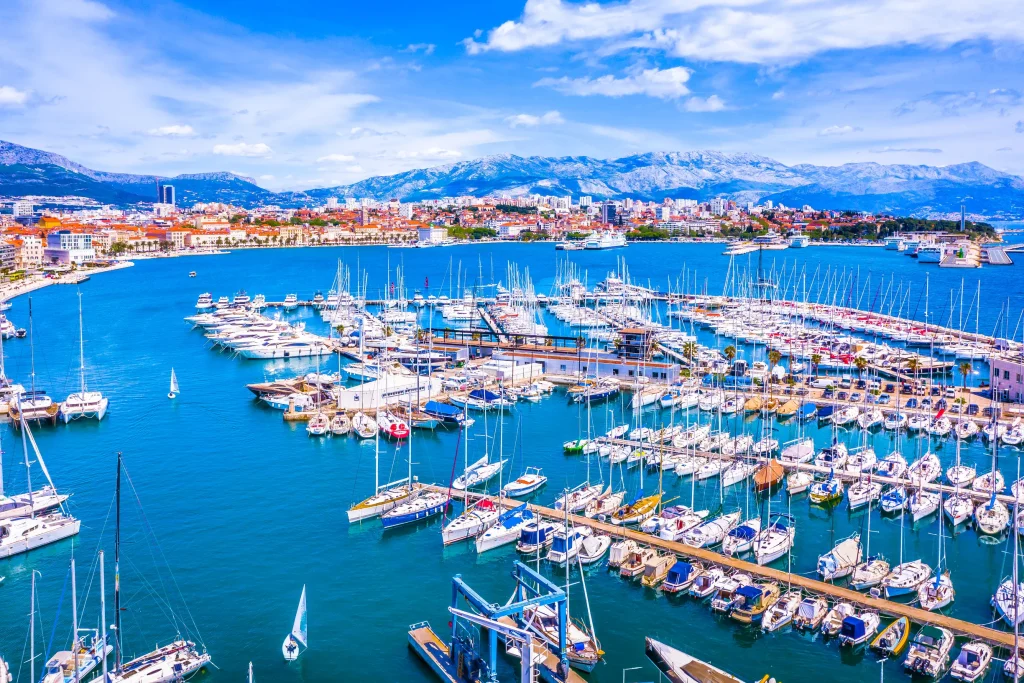
ACI runs 22 marinas along the Croatian coast, from Umag to Dubrovnik. Stern-mooring berths are wired for shore power and water; reception desks speak English, Italian, German. Berthing costs for a 50-foot catamaran in shoulder season are 80–130 EUR a night, peak 150–220 EUR. Compared to Italy or France, this is roughly 30–50% cheaper for comparable infrastructure.
Croatia’s MMK and NauSys network agencies operate under a single national licence regime. Skipper costs are 200–280 EUR a day, hostess 150–220 EUR, professional chef 280–380 EUR. Tipping is normal but not expected at fixed percentages. Insurance requirements are clear and documented in the contract.
The mix of long sailing days, long swimming stops, and short evening hops in and out of konobas adds up to a week that feels rich rather than busy. Charter guests often come back the next year asking for the same boat. Lagoon 50, Bali 5.4, Saona 47 — these three models account for the bulk of repeat catamaran bookings on the Dalmatian coast.
Charter weeks run Saturday-to-Saturday. Book 6–9 months ahead for July and August, 2–4 months ahead for May, June, September. Browse our Croatian catamaran fleet with cabin layouts and pricing per week, or use request a quote to lock in a specific catamaran with crew options.
For destination planning, see Split as a charter base, Dubrovnik as a base, or our ready-made Croatian itineraries from 7 to 14 days.
Bareboat: 8,000–22,000 EUR per week for a 45–55 foot cat depending on age and season. Crewed: add roughly 4,500–6,500 EUR for skipper, hostess, and provisioning. Peak July/August adds 25–40% to the bareboat base.
A 47–52 foot catamaran with 4 double en-suite cabins. Lagoon 50, Bali 5.4, or Fountaine Pajot Saona 47 are the typical fleet picks for a family or two-couple group of eight.
For bareboat, yes — RYA Day Skipper or Yachtmaster, ICC, or equivalent national certificate, plus a VHF licence. If you don’t hold one, we book a professional skipper alongside the boat at 200–280 EUR per day.
The Bura is most active October–April but can hit June through September in the northern Adriatic (Velebit Channel, Kvarner). Charter weeks routed via Dubrovnik–Vis–Hvar–Brač in summer rarely encounter Bura conditions. Forecasts are reliable 24–48 hours out via DHMZ and meteo.hr.