By-the-Cabin Catamaran Cruises in Croatia: How Shared Cat Weeks Work
How shared, by-the-cabin catamaran weeks in Croatia work, what they cost per person, and who they suit.
Read more
A catamaran charter Croatia from the USA got a great deal simpler in 2026. United flew Newark to Dubrovnik every day through the summer and added Newark to Split three times a week, so for the first time an East Coast crew could board in New Jersey and step off in Dalmatia without a European connection. If United repeats that pattern in 2027, the hardest part of the trip becomes choosing the week.
This guide is for American sailors and first-timers alike: how the nonstops shape a 10-day vacation, which of your sailing certificates Croatia actually recognizes, what feels different after the BVI or the Chesapeake, and what a week on a 42-foot catamaran costs in dollars.
In summer 2026 United ran Newark to Dubrovnik daily from 1 May and opened Newark to Split on 30 April with three weekly flights on a Boeing 767: out on Tuesday, Thursday and Saturday, back on Wednesday, Friday and Sunday. It was the only US nonstop into Split. The 2027 timetable had not been published when we wrote this in November 2026, so treat those days as a strong hint rather than a promise, and check before you book anything non-refundable.
The Split days fit a charter week remarkably well. Croatian charters run Saturday to Saturday, so a Thursday evening departure from Newark lands you in Split on Friday, gives you a night ashore to shake off the overnight flight, and puts you on the boat on Saturday afternoon. The following Saturday you hand the boat back, spend a night in Split or Trogir, and catch the Sunday flight home. Ten days, one long-haul flight each way, no connections.
Dubrovnik’s daily service is more forgiving when your dates are fixed by work or school. Delta has flown JFK to Dubrovnik in past summers; check whether it returns. From the West Coast and the Midwest the realistic answer is still one stop, through Newark itself or a European hub. In summer Croatia is six hours ahead of New York and nine ahead of Los Angeles.
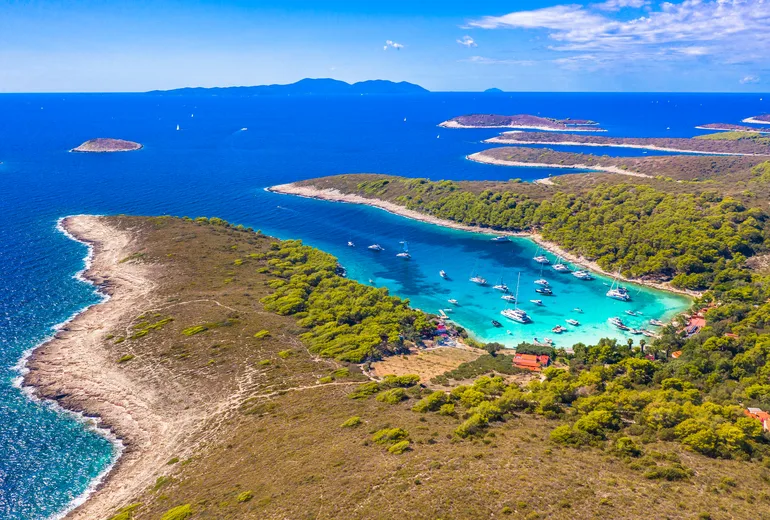
Split is the bigger base. Most of the fleet sits in the marinas around Kaštela, Trogir and the city itself, all within half an hour of the airport, which means more boats to choose from and sharper prices in the shoulder weeks. The sailing is classic central Dalmatia: Šolta, Brač, Hvar and the Pakleni islands, with Vis further out for a crew that wants open water. Our guide to choosing between Split, Trogir and Šibenik as a 2027 base compares the marinas one by one.
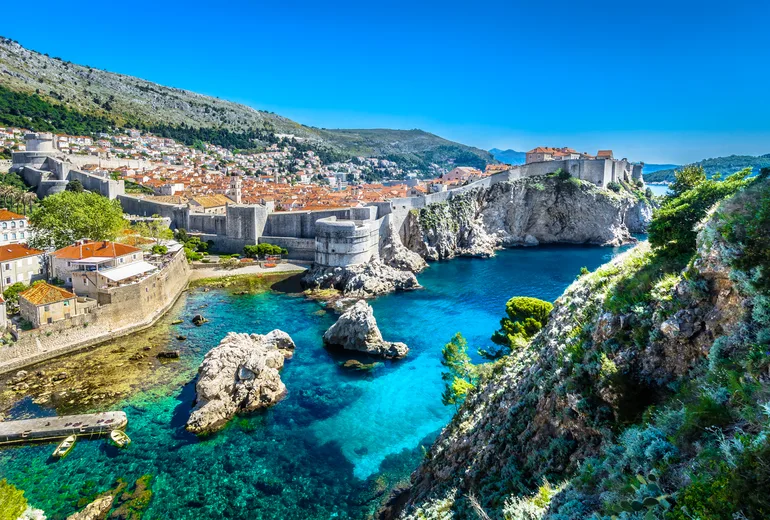
Dubrovnik is smaller, with fewer catamarans and a quieter cruising ground. The Elaphiti islands, Mljet and Korčula carry a week there, and the legs run a little longer. Two nights inside the old town walls round off the trip nicely.
A third option uses both nonstops. Fly into Split, sail south past Hvar and Korčula, return the boat in Dubrovnik and fly home from there. One-way charters usually carry a transfer fee and not every boat offers them, so ask early. For a first charter we generally suggest Split; for a crew that has sailed the Adriatic before and wants the southern islands, Dubrovnik.
The biggest adjustment is mooring. In the BVI most nights end on a mooring ball, and on the Chesapeake in a slip with finger piers or at anchor in a creek. Croatian marinas and town quays use Mediterranean mooring: you back in, stern to the quay, and pick up a lazy line, a heavy rope running from the quay to a weight on the seabed, which you walk forward and cleat at the bow. A catamaran makes this easier than it sounds, because two engines set far apart let you steer in reverse with real precision. Practice once in the marina before you leave.
There are mooring buoys in Croatia, but far fewer than in the Virgin Islands. Where they exist they are usually laid by a concessionaire or a nature park, cost a nightly fee collected by boat, and fill early in July. Expect to anchor far more than in the BVI, so get comfortable letting out 40 to 50 meters of chain on sand or seagrass.
The water itself is different too. There is no meaningful tide in the Adriatic, which removes a whole layer of Chesapeake planning, and very few shoals: depths drop fast, so you anchor in 6 to 10 meters close to the rocks. Instead of a steady trade wind there is a daily rhythm. Mornings are often calm, the northwesterly maestral fills in around midday at 10 to 20 knots, and it fades toward sunset. Plan longer legs for early afternoon and you sail more and motor less.
Evenings ashore have their own culture. A konoba is a family tavern, often with a wood-fired grill, where fish is weighed and priced by the kilo, peka (lamb or octopus slow-cooked under an iron bell, usually ordered a day ahead) comes to the table in its pan, and the wine is local Plavac Mali or Pošip. Dinner starts late by American standards, rarely before eight.
Croatia is not the United States when it comes to tipping, and it is not a no-tip country either. In restaurants, rounding up or leaving around 10 percent for good service is common and appreciated, but nobody expects the 18 to 20 percent Americans are used to. Marina staff who take your lines do not expect a tip.
With a skipper the custom shifts. Many crews tip the skipper at the end of the week, and on fully crewed boats the usual range is 5 to 15 percent of the charter fee, in cash. Our post on how much to tip a skipper in Croatia covers what is normal and when to give more.
Croatia uses the euro. Cards work in marinas, supermarkets and most restaurants, while buoy fees, small konobas and island bakeries often prefer cash, so carry a few hundred euros. When a terminal offers to charge you in dollars, choose euros.
Croatia does not leave this question entirely to the charter company. The Ministry of the Sea, Transport and Infrastructure publishes a table of foreign certificates it recognizes, and several American qualifications are on it. The tiers matter, because charter catamarans run from about 40 to 59 feet:
Here is the trap. ASA Basic Keelboat and Basic Coastal Cruising appear on the list as well, but only for boats staying within 6 nautical miles of the coast, which will not get a charter catamaran out to Vis or Lastovo. A state boater education card is not on the list at all; it is a safety course for home waters, not a skipper qualification. A USCG captain’s license is a commercial credential and is also absent from the table, although some charter companies may accept it alongside a solid sailing resume.
Two more requirements apply to every foreign skipper. Charter boats carry a VHF radio, so you also need a VHF radio operator certificate, national or foreign; check with us which one you hold before booking. And the charter company will still ask for a sailing resume showing time on boats of similar size. An ICC from any issuing country is recognized too. If none of this fits, a skipper removes the paperwork, and our page on whether you need a boating license to charter a catamaran in Croatia walks through the options.
US citizens do not need a visa for Croatia. You can stay up to 90 days in any 180-day period in the Schengen area, which Croatia joined in 2023, and those days are pooled with Italy, Greece, France and the rest. A 10-day trip comes nowhere near the limit. Your passport should have been issued within the last 10 years and be valid at least three months beyond the day you leave Schengen; many advisers say six.
Since April 2026 the EU Entry/Exit System has replaced passport stamps. On your first entry the border officer takes your fingerprints and a photo, which can make the line at Split or Dubrovnik slower than you expect on a summer afternoon.
There is no ESTA-style form for Europe yet. The EU’s ETIAS authorization, around €20, is not required as of November 2026, has no official start date and is expected in 2027 at the earliest. Check the EU’s official travel-europe site a few weeks before you fly.
Prices on this site are in euros, and the euro figure is the contract price; browsing from the US you also see a dollar conversion. Exchange rates move, so the dollar figures below assume roughly $1.15 to $1.20 per euro and should be read as a guide, not a quote.
Shared by eight people, a mid-June week usually lands somewhere around $650 to $950 per person for the boat, before flights and food. That compares well with a winter week in the BVI, where a similar catamaran typically costs $6,000 to $12,000. Our full cost guide for a Croatian catamaran rental breaks the numbers down by month and boat size, and the guide to Croatian marinas and their fees explains when a berth is worth paying for.
American demand for Croatia clusters around a few dates, and so does everyone else’s. The week of 4 July falls at the start of the European peak, when German, Austrian and Italian families are also on the water and the best 42-foot catamarans for eight people go early. If you want Independence Day week in summer 2027, book it during the winter of 2026/27, ideally before the end of January. Our 2027 sell-out timeline shows when each size of boat typically disappears.
US school summer runs roughly from mid-June to late August, which overlaps the busiest Croatian weeks. Families with some flexibility do well in the second half of June, when the sea has warmed and prices still sit below the August peak. Memorial Day week in late May is early season: cooler water, empty anchorages, lighter wind and lower rates. Labor Day week in early September is our favorite American option, with the sea at its warmest, European school holidays over and prices starting to ease.
In summer 2026 United flew Newark to Dubrovnik daily from 1 May and Newark to Split three times a week from 30 April. Check whether United repeats the pattern in 2027; from other US cities you connect once.
Yes. ASA 104 Bareboat Cruising and US Sailing Bareboat Cruising are on Croatia’s official list for bareboat yachts up to 18 m, which covers nearly every charter catamaran. You also need a VHF radio certificate, and the charter company will ask for a sailing resume.
Neither is on Croatia’s list of recognized foreign certificates. Some charter companies may accept a USCG license with a strong sailing resume, but a state boater card will not get you a bareboat. ASA 104, US Sailing Bareboat Cruising or the IPC are the straightforward routes, or you can take a skipper.
No visa is needed for stays up to 90 days in any 180-day period across Schengen. ETIAS was not in force as of November 2026 and has no official start date; it is expected in 2027 at the earliest, so check the official EU site before you fly.
A 40 to 42-foot bareboat catamaran costs about $3,600 to $9,000 outside the peak and $6,900 to $14,200 in July and August, at $1.15 to $1.20 per euro. Add roughly $1,400 to $2,400 in running costs for eight people, plus about $1,600 to $2,100 for a skipper if you need one.
Compare the Croatian catamaran bases from Split to Dubrovnik and send us your dates; we will tell you honestly which boats are still free for July 4th week.
Your privacy
You can read more about how we protect your personal data and use cookies in our Privacy Policy.
With your consent, we and Google use cookies and similar technologies to store and access information on your device and to process personal data such as your visit to this website, your IP address and cookie identifiers. You can withdraw your consent at any time through “Cookies Settings” at the bottom of every page.
We and Google process data for:
Website analytics and visit statistics, recordings of visits to improve the website, ad measurement and remarketing, storing and accessing information on your device