8 Friends, 4 Cabins, 1 Catamaran: How Group Life Aboard Actually Works in Croatia
What life aboard is really like for eight friends sharing a four-cabin catamaran in Croatia: space, water, privacy and cost, honestly.
Read more
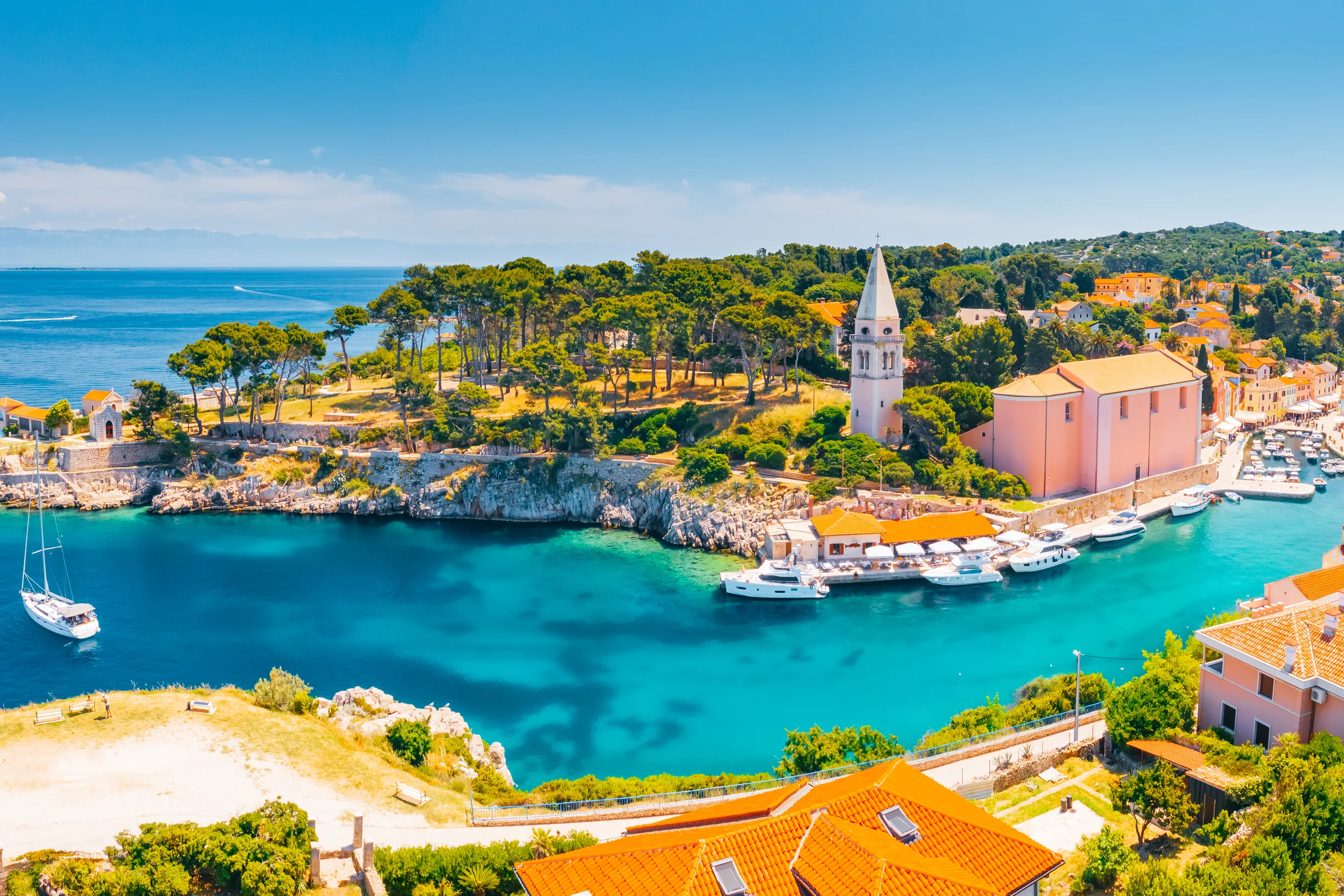
Most charter crews point their boats south from Split and never look north. That’s exactly why Kvarner gulf sailing stays one of Croatia’s best-kept secrets. The waters between Cres, Lošinj and Rab carry a fraction of Dalmatia’s traffic, the islands feel wilder, and in September you can have whole bays to yourself.
This is a region guide written from the water, for catamaran crews. We’ll cover the griffon-vulture cliffs of Cres, Lošinj’s pine-scented harbours, Rab’s surprising sandy beaches, and the honest wind cautions that keep this gulf off the beginner circuit. None of it is hard sailing, but the bura deserves respect.
Two things keep the crowds out. First, geography: Kvarner sits in the northern Adriatic, a longer transfer from the big Split fleets, so fewer bareboats start here. Second, reputation, the bura wind that funnels down the Velebit channel has scared off generations of charterers. Both are real, but both are manageable, and the payoff is solitude.
The main bases are around Krk (Punat, with its big marina) and Mali Lošinj. From either, the core triangle of Cres, Lošinj and Rab is a comfortable week of short hops, most legs well under 20 nautical miles. A catamaran suits it perfectly: shallow draft for the sandy Rab and Lošinj coves, and stable decks for the occasional lumpy channel crossing.
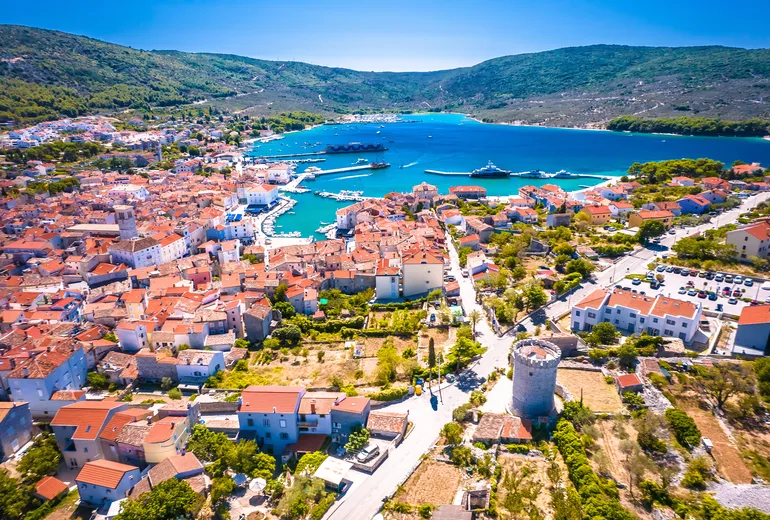
Cres is one of the largest and emptiest islands in the Adriatic. Its eastern cliffs are home to a protected colony of griffon vultures, and you’ll often see them wheeling overhead as you sail the channel toward Beli. The northern half is wild scrubland and freshwater Lake Vrana; the south softens into pine and olive.
Cres town wraps around a near-perfect Venetian harbour, with a quay you can med-moor to and a ring of konobas serving the local lamb the island is known for. A few miles south, the tiny fishing village of Valun sits at the head of a sheltered bay, with a pebble beach and a couple of waterfront restaurants. Holding in the bay is good on sand, though it’s exposed to the south, so check the forecast before committing to an overnight.
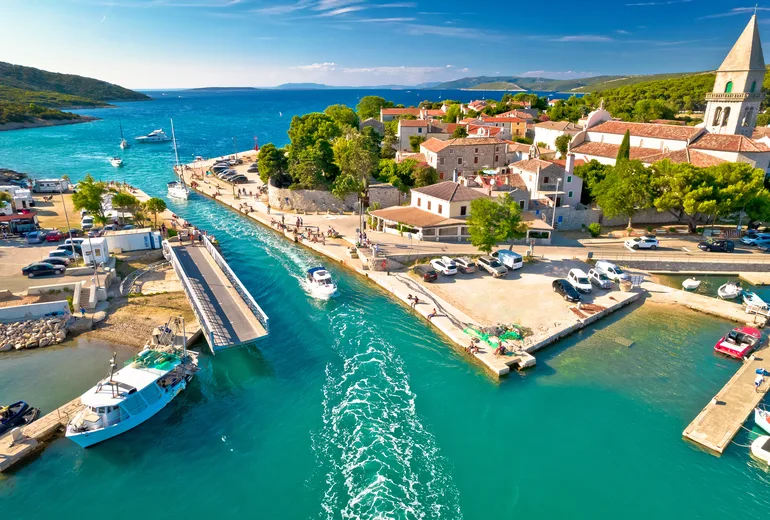
Between Cres and Lošinj lies one of the most charming passages in Croatia: the Osor canal, a narrow man-made cut spanned by a swing bridge that opens twice a day, typically around 09:00 and 17:00. Time your arrival, motor through past the old bell tower, and you’ve shortcut the whole southern tip. Anchoring just outside to wait for the bridge is a pleasure in itself.
Lošinj markets itself as the “island of vitality” for its aromatic microclimate, and the pitch holds up. The hillsides are thick with Aleppo pine, myrtle and wild sage, and the scent carries out over the water on a warm evening.
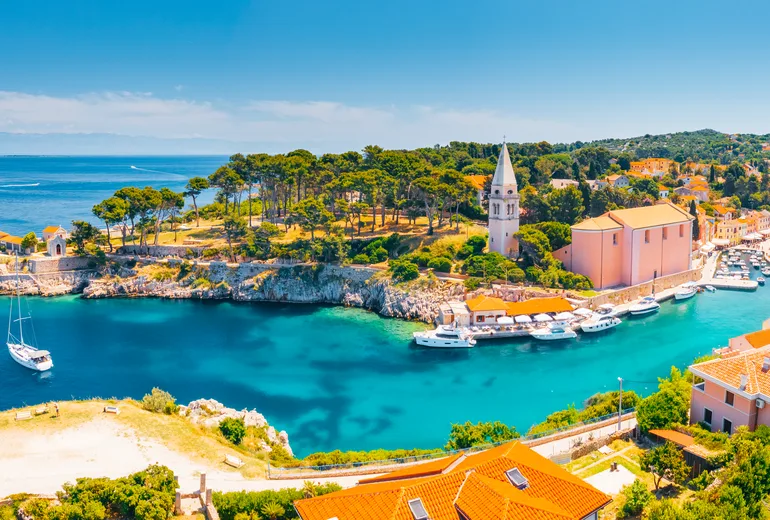
Mali Lošinj sits at the end of a long, deeply sheltered bay, one of the safest natural harbours in the Adriatic and a reliable bolt-hole if the wind turns. The waterfront is busier than Cres but still relaxed, with good provisioning and a clutch of seafood spots. Round the headland, Veli Lošinj is the prettier stop: a pink church, a tight cove of pastel houses, and dolphins regularly working the channel offshore. There’s a resident Adriatic dolphin research project here, and sightings are common rather than lucky.
For anchoring, the Lošinj coves toward Susak and Ilovik offer turquoise sand-bottomed bays that almost no one visits in shoulder season. Ilovik in particular, with its channel between the island and tiny Sveti Petar, is a classic quiet overnight.
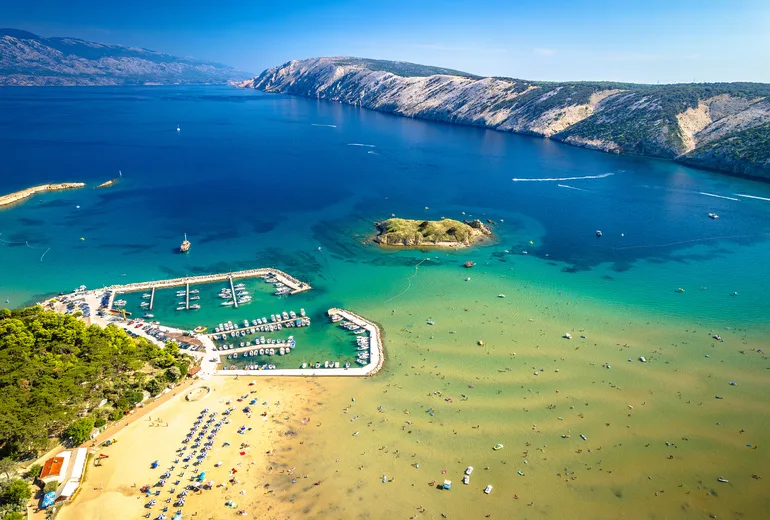
Rab is the surprise of the gulf. Where most Croatian islands are pebble and rock, Rab’s Lopar peninsula hides genuine sandy beaches, Rajska plaža (haven Beach) chief among them, shallow enough that kids can wade out fifty metres. For families on a cat, the shallow draft lets you tuck in close.
Rab town itself is unmistakable from the water: four Romanesque bell towers rising in a line above the old quarter, a skyline you’ll recognise from every postcard of the island. Med-moor in the town harbour or anchor in Sveta Eufemija bay nearby. Ashore, the town rewards a wander, and the local Rapska torta, a marzipan cake, is worth tracking down.
To turn the region into a route, here’s a relaxed seven-day loop most crews find comfortable, starting and finishing at Punat on Krk. The legs are deliberately short so you spend more time swimming than steering.
Nothing here exceeds 20 nautical miles, which leaves room to linger or to sit out a windy morning. If you want to push further, the route extends naturally south into the Zadar archipelago.
Kvarner eats differently from Dalmatia. Cres is famous for its lamb, grazed on wild sage and salt-spray scrub, which gives the meat a distinctive flavour, order it spit-roasted or under the peka in a Valun or Cres-town konoba. Lošinj leans seafood, with the day’s catch grilled simply and dressed in local olive oil. The northern Adriatic also produces excellent shellfish, and you’ll find scampi (škampi) from the Kvarner bay on most menus, often served buska, in a garlic and tomato sauce you mop up with bread.
For wine, look for Žlahtina from nearby Vrbnik on Krk, a crisp, easy white that suits the seafood and barely leaves the region. A bottle bought at the source costs a fraction of what you’d pay in a Hvar restaurant. Provision your staples in Mali Lošinj or Cres town, where the supermarkets are well stocked, and top up bread and produce from the small island shops as you go.
Kvarner’s reputation rests on the bura, a cold, gusty north-easterly that accelerates off the Velebit mountains and can rise fast, especially in the Velebit channel east of Rab. In summer it’s far less frequent than in winter, but when it blows it blows hard, sometimes 30 to 40 knots in gusts, with little warning beyond a clear, sharp-edged sky and a dark cap over the Velebit ridge.
The practical rules most crews follow: check the forecast every morning, favour the western and southern sides of the islands when bura is forecast, and treat the Velebit channel as a fair-weather route only. The southerly jugo brings rain and swell rather than violent gusts, but makes south-facing anchorages uncomfortable. A wide catamaran handles both better than a monohull, but neither wind is something to ignore. If you want a wider primer on Adriatic conditions, our notes on weather for sailing in the Zadar area just to the south give useful context.
If there’s a perfect time for the Kvarner gulf, it’s September. The sea is still warm from summer, often 23 to 24°C, the bura is rarer than in autumn proper, and the few summer crowds have thinned to almost nothing. Bays that hold a dozen boats in August might hold two. The light goes golden earlier, the konobas are calmer, and prices ease.
It pairs naturally with the quieter northern Dalmatian islands just south. If this route appeals, our quiet-north catamaran route through Zadar, Silba, Ist and Molat covers the next archipelago down, and you could conceivably link the two on a longer trip. For crews coming from the Istrian side, the Istria catamaran charter guide and the seven-day itinerary from Pula show how to approach Kvarner from the north-west.
Yes, especially if you value quiet over nightlife. Cres, Lošinj and Rab offer short hops, wild scenery, sheltered harbours and a fraction of Dalmatia’s boat traffic. The main caveat is the bura wind, so it suits crews comfortable reading a forecast rather than absolute beginners.
The two practical bases are Punat on Krk, which has a large marina and easy road access, and Mali Lošinj, deeper into the gulf. From either, the Cres–Lošinj–Rab triangle is a relaxed week of legs mostly under 20 nautical miles.
The bura can rise fast and gust 30 to 40 knots, particularly in the Velebit channel east of Rab. It’s far less frequent in summer than winter. With daily forecast checks, by favouring sheltered western and southern anchorages, and by avoiding the Velebit channel in unsettled weather, most crews sail the gulf without incident.
Rab is the standout. The Lopar peninsula has genuine sandy, shallow beaches like Rajska plaža, unusual for Croatia. Lošinj and the smaller islands of Susak and Ilovik also have sand-bottomed bays that are excellent for anchoring and swimming.
September is the sweet spot, with sea temperatures still around 23 to 24°C, rare summer bura, and bays nearly empty after the August crowds leave. June is the other strong option, before peak season builds.
Tempted by Croatia’s quietest charter waters? Explore route ideas and available boats for the north on the Croatia catamaran destinations page.