Catamaran Charter Croatia from Canada: the Montreal Nonstop, Licences and a Dubrovnik Route
The 2027 Montreal to Dubrovnik nonstop, the PCOC licence trap, a two-week summer plan, a Dubrovnik route and weekly costs in Canadian dollars.
Read more
For a first week, the best place to sail in Croatia by catamaran is the stretch from Split to Brač, Hvar, Vis and Korčula, where the islands sit close together and you can mix town quays, marinas and quiet bays in seven days. If you’d rather have emptier water, go north to Dugi Otok, Silba and the Kornati, or south to Mljet and the islands near Dubrovnik. Our guests most often choose Split with Brač, Hvar, Vis and Korčula, and for a first charter that’s the area we’d suggest too.
The best places to sail in Croatia fall into five areas, and each one sails differently:
Istria is the peninsula next to Slovenia, with Venetian towns such as Rovinj on its west coast and Pula with its Roman arena at the southern tip. Off Pula lie the Brijuni islands, a national park. Our seven-day catamaran itinerary from Pula follows a week that starts at the southern tip of Istria.
Kvarner is the gulf east of Istria, with Cres, Lošinj, Krk and Rab. The islands are large and the hops between them longer. This is where the bura has its reputation. Croatia’s weather service, DHMZ, calls the bura the prevailing wind of the northern Adriatic, strongest under the Velebit mountains and typical of the cold part of the year, so in spring or autumn you plan each day around the forecast. Our Kvarner guide to Cres, Lošinj and Rab explains how to sail the gulf.
Silba, north-west of Zadar, has no cars. The Zadar Tourist Board says only water delivery vehicles, small mopeds and bicycles are allowed, and bicycles are banned in peak season. The only village sits where the island is 700 m wide, about a ten-minute walk from one coast to the other. So you can anchor on the side that’s out of the day’s wind and still walk in for dinner, past the 15 m stone tower called Toreta. Our quiet northern route from Zadar to Silba, Ist and Molat builds a week around them.
Dugi Otok means Long Island in Croatian. At its north-western tip near Veli Rat stands a lighthouse built in 1849 and 42 m high, and at the south-eastern end lies Telašćica bay, a nature park since 1988 with its own boat ticket.
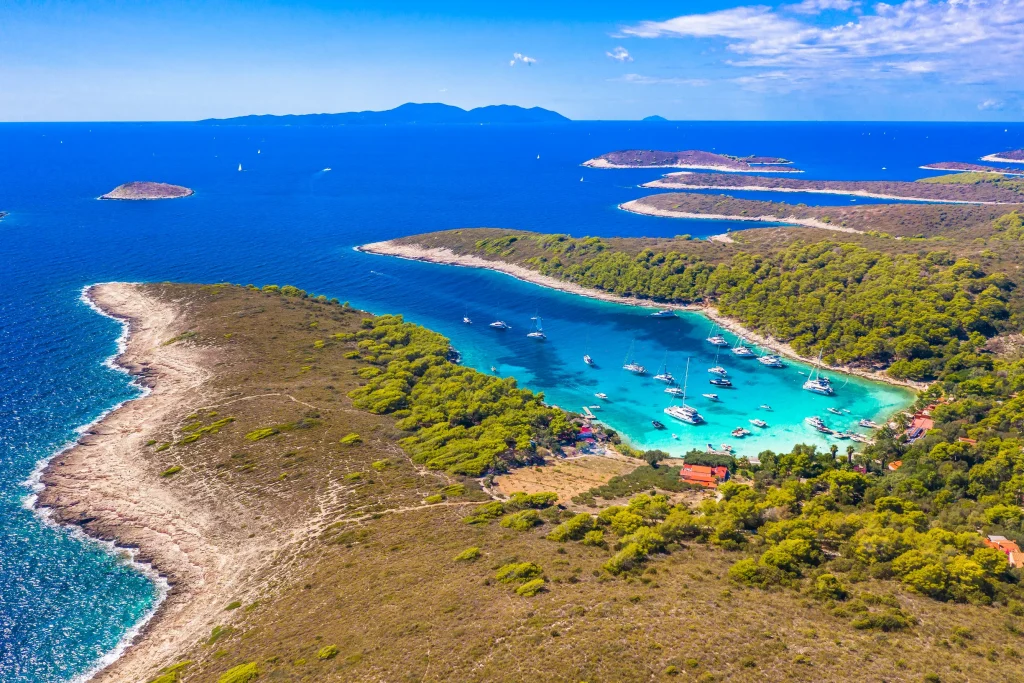
At the southern end of this chain of islands lie the Kornati, a national park of bare, stony islands with only a few konobas and moorings. The park allows anchoring and overnight stays only in listed bays, among them Lavsa, Ravni Žakan, Statival, Opat and Vela Panitula on Piškera. ACI Piškera, between Piškera and Panitula Vela, is open from 1 April to 31 October and, by ACI’s own notes, well protected from the bura but less so from southerly winds.
Every boat in Kornati National Park needs a ticket. On the park’s 2026 price list, a boat of 11 to 17.99 m pays for one day from June to September:
Buy it online before you sail in. Our guide to the Kornati islands on a catamaran covers the anchorages. For a whole week, our one-week sailing route from Zadar runs through the Kornati and the islands around them.
Šibenik sits at the mouth of the Krka river, and the marina in town is D-Marin Mandalina. Kaprije lies in the middle of the Šibenik archipelago and takes its name from the caper plant. Its village bay is on the south-west side. The county tourist board describes it as protected from all winds, one reason so many yachts call there.
Primošten is down the coast towards Split, an old town on a peninsula, with the church of St George and its bell tower above the roofs. Three kilometres south, on Bucavac hill, the Babić vines grow in small plots inside dry-stone walls. Marina Kremik lies in the uninhabited Kremik bay near the town. Call the marina on VHF channel 17 as you come in, and the sailor on duty meets you at the first pontoon.
The unusual day in this area is the river. A catamaran can motor up the Krka to Skradin, where ACI has a marina at the edge of Krka National Park. According to ACI’s approach notes the river narrows to about 100 m in places and later to 80 m, and boats keep to the starboard side. Our post on Split, Trogir or Šibenik as a catamaran base compares the three starting points.
On the west coast of Brač, Milna lies at the head of a long, deep bay, and ACI Milna sits at the end of that bay opposite the town centre. Our Brač catamaran guide to Milna, Bobovišća and Lučice lists the other bays.
Šolta’s north coast faces Split. Maslinica is the only village and harbour on its west coast, and next door is Šešula bay, which the Šolta tourist board describes as a natural, safe anchorage. Our Šolta guide to Maslinica and Šešula covers both.
Hvar town has no marina. Its town quay takes boats overnight when there is room. If it’s full, the nearest ACI marina is Palmižana on Sv. Klement, the largest of the Pakleni islands. ACI puts it 2.4 NM from Hvar, and it is open from April to the end of October. Stari Grad, on the north side of the same island, is a town quay as well.
Vis lies further out, and Vis town has a town quay. On the west side, the port of Komiža has berths on the waterfront and mooring buoys in the bay in summer, and the Komiža tourist board says it works first come, first served, with no reservations. The crew that gets in first gets the berth. Our guide to Vis by catamaran goes bay by bay.
Korčula town stands on a small walled peninsula on the north-east of its island, across the Pelješac Channel from the Pelješac peninsula. ACI Korčula is in the eastern part of the town harbour, next to the old town. Our Korčula guide to Badija and Lumbarda covers the anchorages nearby.
Ston sits on the narrow neck of Pelješac. Its walls, built by the Republic of Dubrovnik, were originally 7,000 m long, the Ston tourist board says, and join Ston and Mali Ston. If Ston is on your list, say so when you ask for an offer, so the route and the night’s berth can be checked for your boat.
Mljet is a long green island whose western part is a national park with two saltwater lakes. Mljet National Park also charges a ticket for each boat. For a boat of 11 to 17.99 m, one day from June to September costs about €90 in the park’s web shop and €100 bought in the park (2026 price list). The park says the boat ticket doesn’t cover the land-based sites or the two lakes. Lastovo, further out, is a nature park.
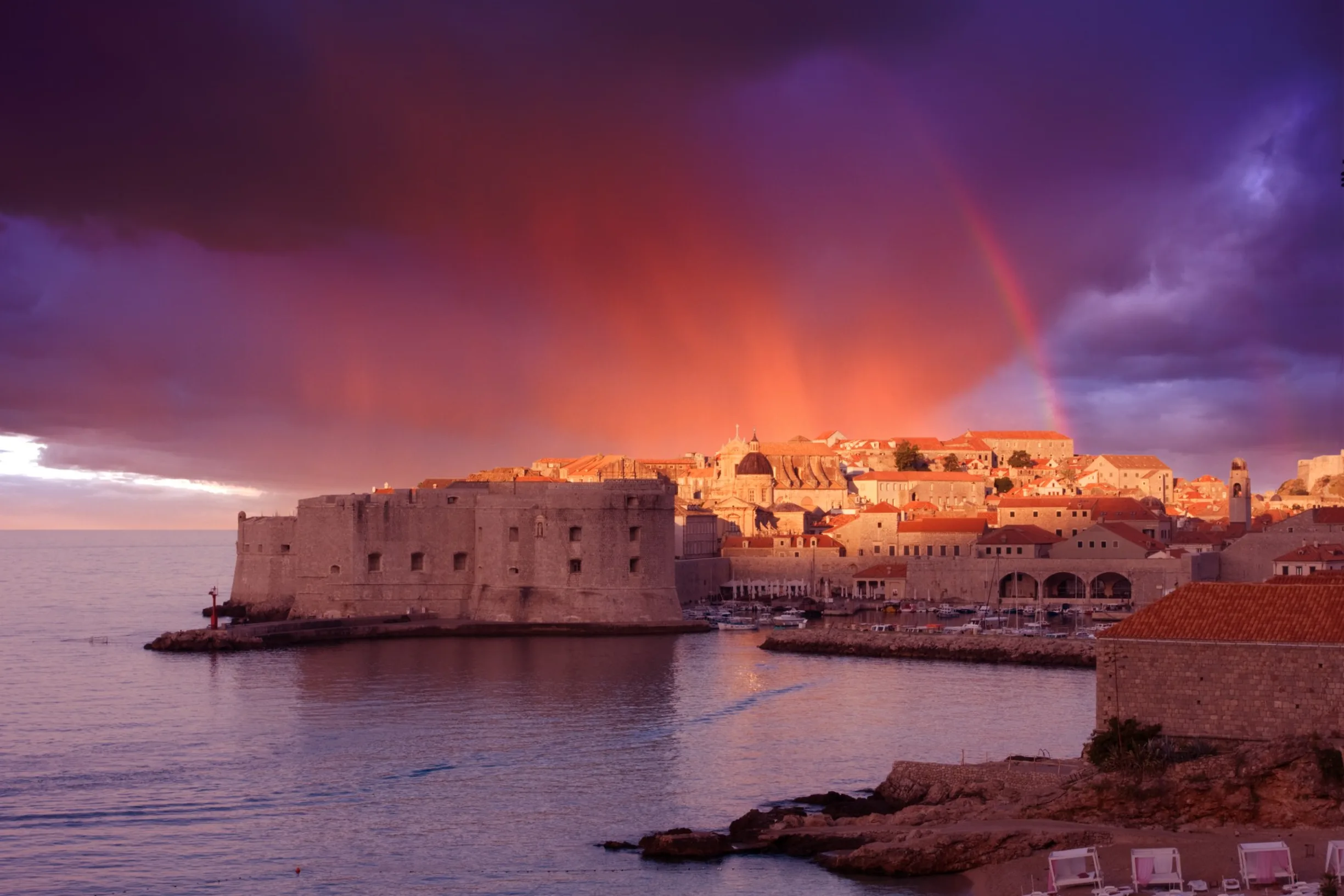
Dubrovnik’s old town is a UNESCO World Heritage Site, but ACI Dubrovnik isn’t next to it. The marina is at the end of the Rijeka Dubrovačka inlet, away from the old town walls. Near Dubrovnik, Koločep, Lopud and Šipan are close together. Lokrum, the island just off the old town, charges every visitor €30 for the reserve, also those who arrive on their own boat (Lokrum Reserve, as listed in November 2026). Slano, up the coast, has the ACI marina Veljko Barbieri.
The south also suits a one-way week between Split and Dubrovnik. Our seven-day sailing itinerary from Split to Dubrovnik gives one such route day by day.
Between May and September, July is the dearest month in our listings and May the cheapest (the weekly figures are in the cost section below). DHMZ’s long-term averages for Split Marjan (1948 to 2024) show how the months compare on land:
In summer, DHMZ describes long spells of clear weather, with a daytime breeze from sea to land on the larger islands and the coast and a night breeze off the land. The jugo, a steady and strong south-easterly, blows harder and more often in the central and southern Adriatic than in the north. Every morning on board, read the DHMZ marine forecast for small craft, which the Marine Meteorological Centre in Split issues with a warning, a synopsis and a forecast for the next 12 hours and the 12 after that. Our post on the best time to sail in Croatia compares the months in more detail.
ACI runs 22 marinas along the coast, and other operators run marinas too, such as D-Marin Mandalina in Šibenik and Marina Kremik near Primošten. Our guide to Croatian marinas and their fees compares ACI with the private marinas.
Town quays such as Hvar, Stari Grad and Vis put you in the middle of town and take boats overnight when there is room.
Buoy fields are anchorages run under a concession or by a port authority, and they charge. The Croatian government’s nautical page says anchoring isn’t charged where there is no concession and no public port, and that anchoring is forbidden in areas marked on the charts of the Hydrographic Institute, with heavy fines. The Kornati park publishes its own buoy locations. Our post on a catamaran week without marinas shows how a crew strings anchorages and buoys together.
The weekly price of the boat doesn’t depend much on the area, but the marina bill does. ACI adds a surcharge for catamarans, and the size of it changes from north to south (ACI price list 2026):
| Area | ACI marinas | Catamaran surcharge on a daily berth in July |
|---|---|---|
| Istria | Umag, Rovinj, Pula, Pomer | 50% in Umag, 80% in Pula and Pomer, 100% in Rovinj |
| Kvarner | Opatija, Cres, Supetarska Draga, Rab | 80% in Opatija, 50% in Cres, Supetarska Draga and Rab |
| Zadar and the Kornati | Šimuni, Žut, Piškera, Jezera | 50% in Žut and Piškera (July and August), 100% in Šimuni and Jezera |
| Šibenik and the Krka | Vodice, Skradin | 100% |
| Split and the central islands | Trogir, Split, Milna, Palmižana, Vrboska | 100% (Milna, Palmižana and Vrboska from 1 June to 30 September) |
| Dubrovnik and the south | Korčula, Slano, Dubrovnik | 80% in Slano, 100% in Korčula and Dubrovnik |
In euros the gap is plain. A catamaran of up to 13 m pays about €198 for a July night in ACI Cres and about €300 in ACI Korčula.
The charter itself is priced per week. Across all Croatian listings, the median weekly price in 2027 is (from our listings, November 2026):
A skipper costs about €1,750 a week on a catamaran in Croatia (from our listings, November 2026). A tip for the skipper is not included in the price and is up to you. Our catamaran charter price guide for Croatia breaks these prices down further.
Split and the central islands. Brač, Šolta, Hvar and Vis are close together, and in one week you can mix marinas, town quays and anchorages.
No. The Hvar town quay takes boats overnight when there is room, and the nearest ACI marina is Palmižana on the Pakleni islands, 2.4 NM away.
No. The park allows anchoring and overnight stays only in the bays on its list, and every boat needs a park ticket, which costs less if you buy it before you enter.
Yes, as a one-way charter such as Split to Dubrovnik, where the boat’s listing allows it. Any one-way fee is shown in your offer.
So where to sail in Croatia comes down to the kind of week first and the boat second. The Kornati and Silba in early June, or Hvar and Vis in August, are two very different holidays, and only your crew knows which one it wants. You can browse every boat by its starting point among our destinations in Croatia.
Your privacy
You can read more about how we protect your personal data and use cookies in our Privacy Policy.
With your consent, we and Google use cookies and similar technologies to store and access information on your device and to process personal data such as your visit to this website, your IP address and cookie identifiers. You can withdraw your consent at any time through “Cookies Settings” at the bottom of every page.
We and Google process data for:
Website analytics and visit statistics, recordings of visits to improve the website, ad measurement and remarketing, storing and accessing information on your device